
Mitsubishi’s Nissan-Powered BMW 5 Series Rival You’ve Probably Never Heard Of
When we think of Mitsubishi as a whole these days, images of cheap-and-cheerful cars come to mind, like the now-defunct Mirage or the Eclipse Cross. Or, if you’re a fan of automotive history, you’ll know about Mitsubishi’s past exploits in the World Rally Championship that spawned the Lancer Evolution. But what you may not know about is the Japanese automaker’s attempts to build luxury cars.
Related
That Time Mitsubishi Turned To AMG For Help With Performance
We don’t normally think of Japanese autos when AMG comes to mind, but Mitsubishi received some help from an unlikely source.
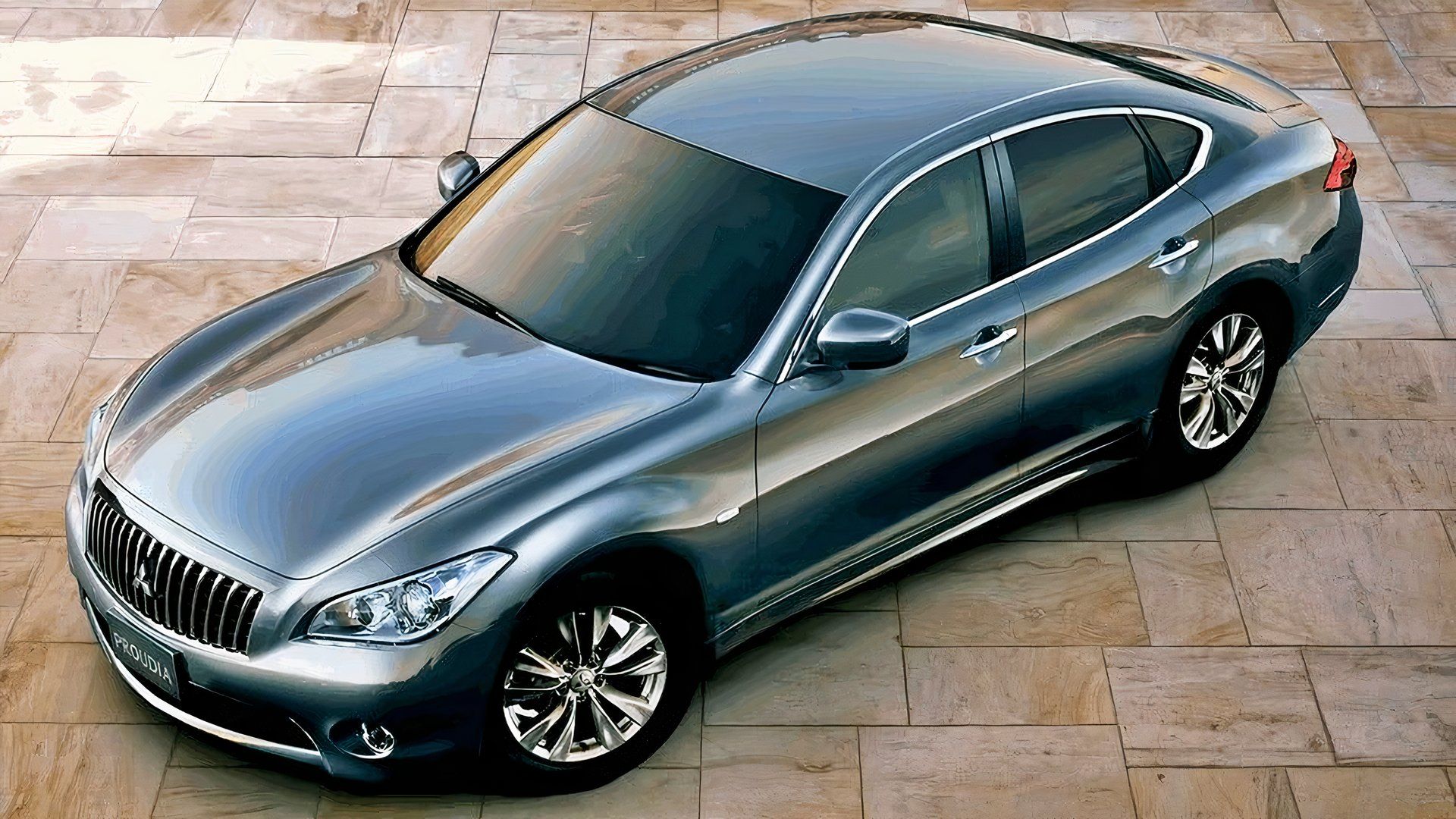
Like many Japanese automakers, many of these more premium offerings never made it out of Japan, where models like the Toyota Century and Nissan President were held in high regard. Mitsubishi’s top dog was the Dignity, but there was another less-well-known luxury sedan to wear the Mitsubishi badge, one that was theoretically a rival to the BMW 5 Series and was powered by Nissan’s most reliable engine family. Confused? So were we when we learned of the second-generation Mitsubishi Proudia.

Mitsubishi
Mitsubishi is a Japanese automaker founded in 1870 and is part of the Mitsubishi Group and broader Renault-Nissan-Mitsubishi Alliance. Mitsubishi Motors officially started producing passenger vehicles in 1917, the Mitsubishi Model-A, before building a legacy as the manufacturer of off-roaders like the Pajero. Mitsubishi established a strong presence in motorsport, with models like the Lancer Evolution competing in WRC and the Pajero Evolution taking multiple wins in the Dakar Rally. Its best-ever sales year in the USA was 2002, when it sold 345,915 cars.
- Founded
- 1870
- Founder
- Yatarō Iwasaki
- Headquarters
- Tokyo, Japan
- Owned By
- Mitsubishi Group
- Current CEO
- Takao Kato
The Proudia Was Never Really A Mitsubishi
You may have already been able to spot the fact that the Mitsubishi Proudia looks suspiciously similar to the Infiniti Q70 sold in the States. That’s because, in many ways, it was an Infiniti M, the luxury sedan later rechristened the Q70. It was technically a rebadged Nissan Cima (the basis for the Infiniti M), primarily differentiating itself from the Nissan with a vertically vaned grille instead of the Nissan’s horizontal chromework. The irony here was that the second-gen Proudia was based on a nameplate from Nissan the first generation targeted as a direct rival.

Add CarBuzz to your Google News feed.
It was launched in 2012 and Mitsubishi hoped it would somehow recover from the dismal sales that befell the first generation model. But Mitsubishi forewent all development and even manufacturing; the Proudia was built entirely by Nissan.
2nd Generation Mitsubishi Proudia Quick Facts
- Built from 2012 to 2016
- Shared underpinnings with the Nissan Cima and Infiniti Q70
- Only minor cosmetic changes differentiated the Proudia from the Cima
While the Infiniti M and Nissan Cima were decent cars, the Proudia struggled. Its second run was shortlived and in 2016, Mitsubishi discontinued the second-gen Proudia, along with its long-wheelbase cousin, the Dignity. Sales figures may have started relatively strong, with 279 cars sold in 2012 (Japanese automakers seldom targeted huge volumes for models like this), but they plummeted thereafter, never reaching triple digits in any subsequent calendar year and totaling 466 units across five years. In an ironic twist, it seems Mitsubishi was anything but proud of the Proudia, scrubbing its existence, including press releases and imagery, from its media websites and treating the second generation as if it never existed.
|
Second Generation Mitsubishi Proudia Sales Volumes |
|||||
|---|---|---|---|---|---|
|
Year |
2012 |
2013 |
2014 |
2015 |
2016 |
|
Cars Sold |
279 |
26 |
77 |
48 |
36 |
The Proudia’s Best Feature Was What Lay Under The Hood
The second-gen Proudia was offered in four trims, ranging from the base 250 to the 250 VIP, the 370 VIP, and the range-topping 370 4WD, but whichever you chose, you got a Nissan powertrain. The Proudia never got the hybrid engine from the Cima – which was reserved for the long-wheelbase Dignity – but instead relied on two V6s from Nissan’s most notable engine family.
|
Mitsubishi Proudia Specs (Second-Gen) |
||
|---|---|---|
|
Engine |
2.5-Liter Nissan VQ25HR V6 |
3.7-Liter Nissan VQ37VHR V6 |
|
Horsepower |
222 hp @ 6,400 rpm |
328 hp @ 7,000 rpm |
|
Torque |
190 lb-ft @ 4,800 rpm |
268 lb-ft @ 5,200 rpm |
|
Transmission |
7-speed automatic |
|
|
Powertrain |
Rear-wheel drive |
Rear-wheel drive / All-wheel drive |
At the entry level, the Mitsubishi Proudia came equipped with a 2.5-liter Nissan V6 (VQ25HR) which, despite its tiny stature, managed to pump out more than 220 horsepower. But the engine you’d want for your Mitsubishi Proudia was Nissan’s 3.7-liter VQ37VHR V6. This was the same motor that saw extensive use in several Nissan products, most notably found in the Nissan 370Z. The VQ37VHR was the first mass-market production Nissan motor to use its then-new VVEL variable-valve timing system.
On top of sharing its engines with Nissan, the Proudia also shared its transmission and drivetrain. Both engine options used the same, seven-speed automatic transmission across all four trim levels. All-wheel drive was offered as an option, but only on the top-of-the-line Proudia 370 4WD grade.
A Name That Deserved Better: The Origin Of The Proudia Name
The second-generation Proudia was an oddity in many ways, not least of which was its name. Japanese automakers have a history of strangely named cars and this was no exception. The Proudia’s origin story began in 1999 when the name combined the words “proud” and “diamond” in reference to the marque’s logo, the nameplate directly replacing the Mitsubishi Debonair that had been in production since 1964 in three generations.
But even the original Proudia wasn’t an entirely in-house-developed model for Mitsubishi. Mitsubishi and South Korean automaker Hyundai struck up a deal to co-develop a flagship luxury sedan for both marques, targeting the likes of the Toyota Crown Majesta. The Proudia flew the Japanese flag, while the South Korean model was known as the Equus – home to one of Hyundai’s most powerful engines ever made. This motor was shared and codeveloped with Mitsubishi, officially classified as the only V8 in the latter’s history: a 4.5-liter V8 capable of 275 horsepower and 304 lb-ft of torque, although the horsepower figure may or may not have been a lie. The base powertrain, however, was a 3.5-liter V6 with 237 hp and 253 lb-ft.
But while the Hyundai Equus had a long career, remaining on sale until 2008, the Proudia was discontinued after just three years, with 1,227 units produced in that time.
How Did The Proudia Stack Up To Its Competition?
In the States, the Nissan Fuga’s sibling, the Infiniti M/Q70, was tasked with competing with German marques like BMW and Mercedes, although the Proudia technically competed against a slew of different Japan-only sedans.
But to understand how it stacked up against the cars of its era, we pulled the specs on the equivalent BMW 5 Series to the top-spec Proudia of the time.
|
2012 Mitsubishi Proudia 370 4WD |
2012 BMW 535 ixDrive |
|
|---|---|---|
|
Engine |
3.7-Liter V6 |
3.0-Liter Turbocharged Inline-Six |
|
Horsepower |
328 hp @ 7,000 rpm |
300 hp @ 5,800 rpm |
|
Torque |
268 lb-ft @ 5,200 rpm |
300 lb-ft @ 1,200–5,000 rpm |
|
0-60 MPH |
5.5 Seconds |
5.6 Seconds |
On paper, the Mitsubishi was more than a match for the 5 Series, but there was one area where it simply couldn’t compete: price. When new, the Proudia started at a base price of 4.02 million Yen – equivalent to $50,400 at the time – but its top-spec model broke the bank at the equivalent of $65,332. Comparatively, the 535i xDrive cost $53,000 at the time, and while we know you can’t directly compare American pricing with Japanese, it’s clear the Mitsubishi was playing in the big leagues.
Today, the BMW 535i xDrive ranges in price from $7,500 to $13,000 on the used market, per AutoTempest, whereas trying to import a Mitsubishi Proudia will cost you as little as $4,400 before shipping. But beware, the Proudia isn’t eligible for import under the 25-year rule, so you’d have to either get it certified or try to get it into the country under a Show or Display permit; an unlikely feat.

Related
Can You Import A New Subaru WRX Sportswagon From Mexico?
With the handsome Subaru WRX Sportswagon’s Mexican release, it’s tempting to consider importing one for yourself, but should you?
In the end, the Proudia was a car Mitsubishi would rather forget, and seemingly has. It never reached meaningful sales figures, and in both generations, production was cut short while its badge-engineered siblings lived long and healthy lives. Perhaps one day, after some years have passed, there will be a niche enthusiast market for one of the most obscure cars in the modern era, but for now, it’s the Mitsubishi-badged BMW 5 Series rival with a Nissan heart and not much else going for it.
Sources:
Mitsubishi,
Gazoo (archived)
,
AutoTempest