
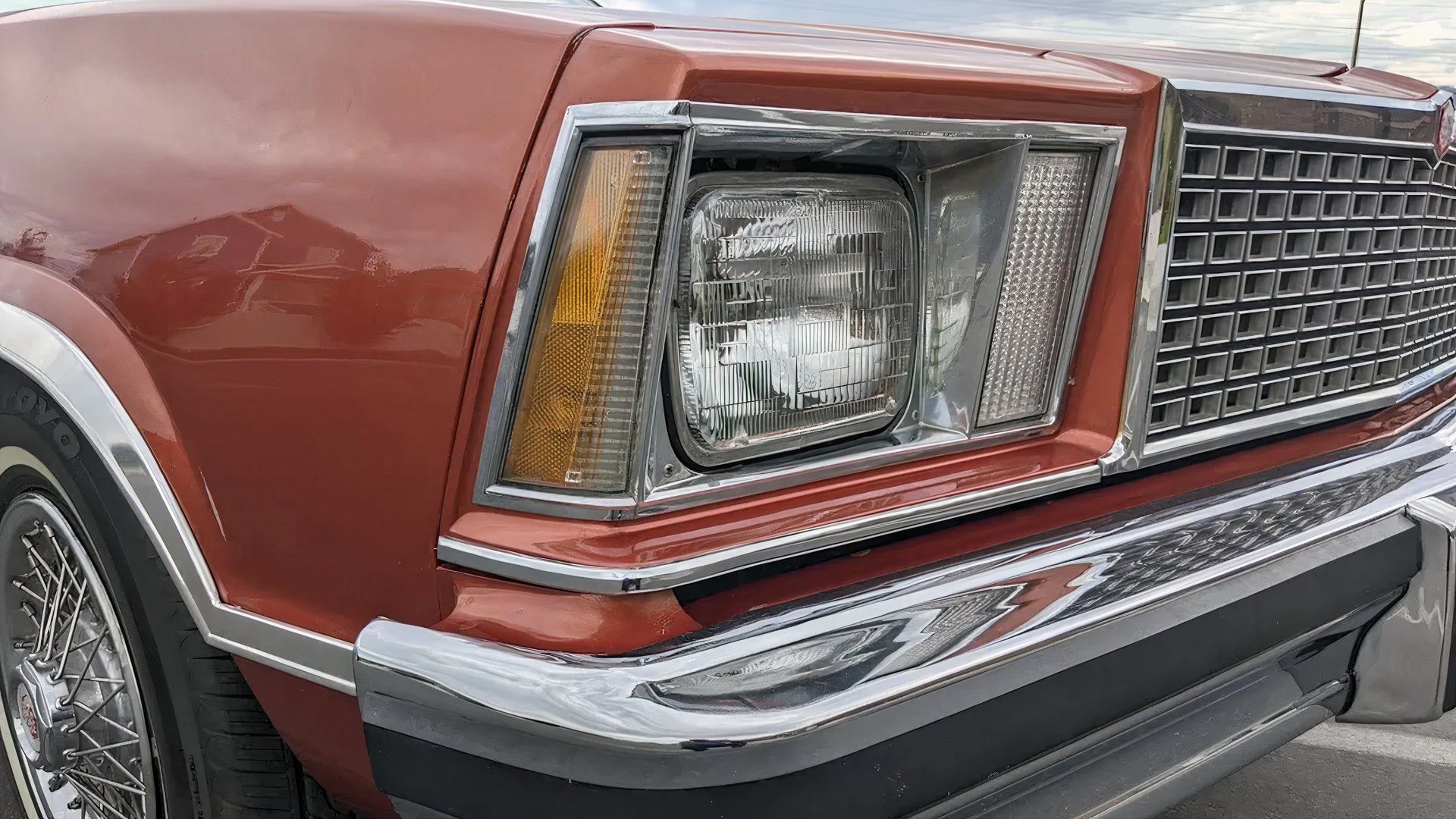
The Chevrolet El Camino’s Forgotten GMC Cousin
The Chevrolet El Camino, an icon of the muscle car’s golden age, and a car with one of the coolest names ever attached to an American automobile, may be the most iconic utility coupe in the history of our vehicle industry, but it was hardly the only car of its type. In fact, it wasn’t even the only utility coupe sold under the General Motors umbrella in the 1970s.
GMC
- Founded
-
1911
- Founder
-
William C Durant
- Headquarters
-
Detroit, Michigan
- Owned By
-
General Motors
- Current CEO
-
Mary Barra
You might remember the Subaru Brat or the Ford Ranchero, but the El Camino’s GMC cousin, the Caballero, is a mostly-overlooked piece of American auto history. This despite it running for three generations across two decades, first under the GMC Sprint name from 1971 to 1977, then relaunching as the Caballero for the 1978 model year, before finally retiring in 1987. Here’s why we think this cult classic ‘ute is a nameplate worth knowing.
The following is based on research into available automotive historical documentation and automotive sales and auction listings. Any opinions or conclusions offered thereupon are those of the author unless otherwise attributed.
A Look At The GMC Caballero
The Caballero began its life launching as the 1971 GMC Sprint, specifically intended to be, essentially, an identical twin to the El Camino. Both cars ran on a Chevelle station wagon-based chassis, and shared the same body styling, for the most part.
Two generations later, the Sprint would be rechristened the Caballero, with cool-sounding Spanish trim names like Diablo, Laredo, and Amarillo. The 1978–1987 Caballero, like the Sprint, shared more in common with the El Camino than not, which helps to explain why the Caballero never managed to compete with the El Camino’s sales numbers. If you saw a Caballero at a distance, you’d assume it was an El Camino, so the car was effectively invisible to the general public.

Related
Suzuki Built Japan’s Answer To The Chevy El Camino
Can you believe Suzuki once produced a pocket-sized coupe utility? This might look like a car for nobody, but it has a devoted following in Australia.
Over the course of the next decade or so, the 1978 Caballero packed one of two engines, being either a 231 CID Buick V6, or a 350 CID Small-Block V8.
|
GMC Caballero |
||
|
Engine |
3.8-Liter NA Buick 6-Cylinder |
5.7-Liter NA Small-Block V8 |
|
Power |
110 hp |
165 hp |
|
Torque |
170 lb-ft |
220 lb-ft |
|
0-60 |
8 Seconds |
10 Seconds |
|
Transmission |
3-Speed Automatic or 4-Speed Manual |
|
|
Drivetrain |
Front-Engine, Rear-Wheel Drive |
|
More engine options would follow in the coming years, including a couple more Small-Block V8s, but the 350 CID remained the most powerful option throughout the late 1970s and the 1980s. The GMC Sprint featured engine badges to show off what you were driving, but, based on all the photos we can find, at least, the Caballeros only featured the usual nameplates and brand badges, with some trim badging in the interior.

Related
Chevy Designer’s Modern El Camino Sketch NEEDS To Happen
But don’t hold your breath.
An El Camino By Any Other Name…
If nothing about this car sounds like it’s worth buying over an El Camino, well, yeah. For all intents and purposes, it was an El Camino. Options packages and trims varied, but the options themselves were the same from brand to brand. Even the exterior paint options between these two cars were identical.
The Short-lived (Lukewarm) ‘Ute Wars
“Wars” is, admittedly, a bit of an exaggeration here. ‘Utes were always a niche in the United States, and American automakers weren’t exactly going at it like Pepsi and Coke to claim the segment, but there was a fair bit of tit-for-tat when you look at that stretch of time around the third quarter of the 20th Century, where Ford, GM, and Dodge were competing to see who could produce the most popular model in the narrow sliver of the market between muscle cars and pickup trucks.
The most iconic mid-century American ‘ute would probably be the Ford Ranchero, launched in 1957. The El Camino would come out two years later as a response to Ford’s popular almost-pickup (although plans for a ‘ute had reportedly been gestating within GM since at least the early 50s). The GMC Caballero’s name suggests its purpose, as Caballero translates roughly to “gentleman,” so this was intended to be a more refined take on a car that we’ve come to associate with drag strips and hot-rodders. Dodge was late to the party, but showed up in time to compete with the Caballero, launching the Dodge Rampage in 1982 with a 2.2-liter inline-four.

Related
Classic 1960 El Camino Pairs Hot Rod Looks With Modern V8 Power
The car has a new chassis, suspension, and engine but retains its classic style.
‘Utes were a part of the American automotive landscape dating back to the pre-war era, as Chevy offered a utility coupe variant of their more popular 1936 Sedan Delivery, and Hudson and Studebaker both had their takes on the body type in 1937, the Terraplane Utility Coupe and the Studebaker Coupe Express.
The 1980s Were A Mildly Exciting Time For ‘Ute Fans
If there was a point in time where competition in the utility coupe niche was especially heated, it would have been in the late 1970s and early 1980s, when the El Camino, Caballero, Dodge Rampage, Ford Durango, and Subaru Brat (Bi-drive Recreational All-terrain Transporter) were all duking it out for supremacy.
‘Utes remain popular overseas, especially in Australia and New Zealand, but if they were a niche market in the US back at the start of the 1980s, they were essentially irrelevant by the end of the decade. By 1990 we had more small pickups than we knew what to do with, like the Dodge Dakota, Ford Ranger, Chevy S-10, and Toyota Pickup. In a country where we enjoy lower-than-average gas prices, thanks to lower gasoline taxes and domestic production, demand for a car with a pickup bed in the back is limited. Nine times of 10, we’ll just take the pickup, thank you.
What’s A GMC Caballero Going To Cost You In 2025?
When you find out that one of your favorite classic cars has a badge-engineered twin, what you hope to discover is that the people selling them don’t know what they’ve got. Unfortunately, for buyers, that does not seem to be the case with the Caballero. It’s a seller’s market.

Related
Is It Possible To Daily Drive A Classic Car In The Modern World?
Can you live with a classic Mini Cooper for a year? We found out the hard way.
Digging up some auction listings for both cars, we turned up a 1978 El Camino with around 72,000 miles on the odometer selling for $9,100 according to a Bring a Trailer listing in 2024. A 1978 Caballero with 62,000 miles sold for $10,000 in 2022. A 1987 Caballero with 88,000 miles on the odometer was selling for $17,600 in early 2024, while a 1987 El Camino with the same engine was selling for $20,000 in 2023 with 70,000 miles. These numbers are close enough to tell you that condition and mileage will go a lot further to determining each car’s sale price than brand name.
In other words, Caballero sellers know what they’ve got: an El Camino. And they’re gonna charge El Camino prices for it.
Sources: Bring a Trailer, El Camino Central, Chevrolet, GMC.