
Automotive Brands That Never Built Anything With More Than Four Cylinders
It’s only normal for auto manufacturers to offer a wide range of engines for their offerings, given most sell vastly different vehicles. Toyota, for example, has a range of economical three and four-cylinder engines in its cheaper vehicles such as Corollas and Camrys. Bigger models such as the Tundra truck get a turbocharged V6 engine, as does Toyota’s flagship premium-brand Lexus models, while sports cars such as the Lexus RC F get a V8.
Related
This Is The Most Versatile Engine Ford Ever Made
From pickup trucks to supercars, this Ford engine has done its job well across the board.
Some brands only focus on a particular sector of the market, meaning larger engines aren’t needed. We decided to track down some manufacturers that have never produced an engine with more than four cylinders.
Any brands that have never built engines featuring more than four cylinders were considered for this feature, with the four brands chosen being the most prolific. All technical data used was sourced directly from the manufacturer.
The Exterior Of Minis Isn’t The Only Small Thing About Them
The Mini brand was first established back in 1969 by the British Motor Corporation, with the cars designed to provide drivers around the world with cheap and versatile transport. The Mini had been around for a decade by the time it became a standalone brand, the car marketed under the Austin and Morris banners for the first ten years of its life. With the main focus on the Mini being compactness and affordability, utilizing large and thirsty engines was out of the question.
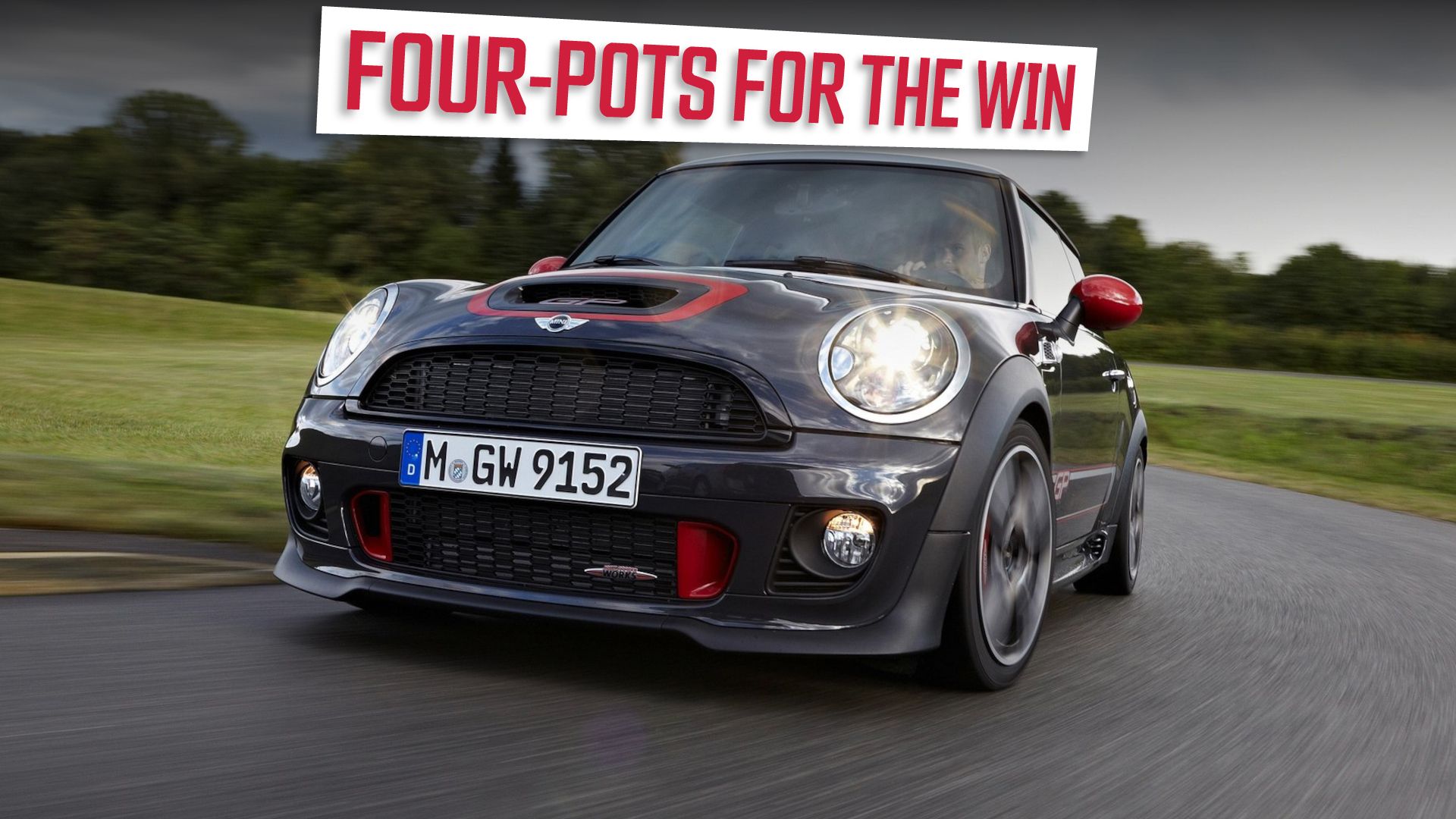
The original Mini was available with a range of small four-cylinder engines, which ran from 850 cc to 1.3 liters in size. They steadily increased in terms of power and size over the years, but always remained four-pots. This trend has continued ever since Mini was taken over by BMW back in 2000, the German manufacturer using gas and diesel engines in the range of models it has offered over the years.
|
Mini Engine History Specifications |
|
|---|---|
|
Engine |
848 cc-2.0L I3 & I4 engines |
|
Power |
20-302 hp |
|
Torque |
40-332 lb-ft |
Aside from the normal Mini model, these have included larger variants such as the Cooper Countryman, the Cooper Clubman, and the Cooper Paceman. Even the most powerful Mini ever built, the 302 hp 2020 John Cooper Works GP, jumped into the hot-hatch arena with a turbocharged 2.0-liter inline-four. In recent years, base Minis have made use of a 1.5L three-cylinder engine. Given the shift to electric propulsion in future years, it’s unlikely a move away from anything bigger than four-cylinder engines will ever happen for the fabled marque.

Add CarBuzz to your Google News feed.
There is simply no need to either, given four-cylinder engines are not only light, more compact, and more efficient than engines with more cylinders, but with a turbo, they can offer a nice level of grunt.

Discussion
Which Engine Would You Pick If You Could Only Pick One?
There’s not an engine on this list that we wouldn’t all gladly take, but if you could pick one and only one, which would you choose, and why?- Lamborghini Revuelto’s 6.5-liter NA V12 PHEV- Ferrari SF90 Stradale’s 4.0-liter twin-turbo V8 PHEV- GMA T.50’s 3.9-liter NA Cosowrth V12- Czinger 21C’s 2.9-liter twin-turbo V8- Pagani Utopia’s 6.0-liter twin-turbo AMG V12- McLaren 750S’s 4.0-liter twin-turbo V8- Ferrari 12Cilindri’s 6.5-liter NA V12- Ford Mustang GTD’s 5.2-liter supercharged V8- Aston Martin Valkyries 6.5-liter NA Cosworth V12 Hybrid- Koenigsegg Jesko’s 5.0-liter twin-turbo V8
Lada Has Resisted The Urge To Build Big Engines
Russian brand Lada was first founded in 1973 by state-owned auto giant AvtoVAZ, and was designed to appeal to the everyday person. Each of its models was built to be as cheap and dependable as possible, given the harsh climate that’s typical across Russia. They were also offered in the Western market, where they were priced significantly lower than most vehicles sold by European brands. Lada even collaborated with Porsche at one point.
|
Lada Engine History Specifications |
|
|---|---|
|
Engine |
644 cc-1.8L I2, I3, & I4 engines |
|
Power |
25-136 hp |
|
Torque |
32-113 lb-ft |
Lada initially worked closely with Italian manufacturer Fiat, using technology and parts from cars such as the Fiat 124 to build its own product line. Its first car, called the VAZ-2101, used a series of four-cylinder engines ranging from 1.2 to 1.5 liters in displacement. With a focus on affordability, Lada has continued to take advantage of four-cylinder engines across the rest of its 50-year history thus far.
Lada Currently Uses In-House Designed I4s
The marque offers a range of compact vehicles in 2024, including the Granta and Vesta sedans and the Niva compact off-roader. Its current I4 engines range in displacement between 1.6 and 1.8 liters, the largest of which features in higher-end versions of the Vesta sedan. It’s not exactly a powerhouse with 122 hp on tap, though it’s ideal for transporting its occupants to their destinations cheaply and efficiently.

Related
The Lada Niva Bronto Desperately Wants To Be A Jeep
We all know “There’s Only One.”
Given Ladas’s general tendency not to offer any performance models for road use – despite taking part in the World Touring Car Championship over the years – don’t expect them to move away from economical and cheap-to-maintain four cylinders anytime soon.
Smart Uses Tiny Engines In Tiny Cars
Another manufacturer to stick to engines with less than four cylinders is Smart, a Mercedes-Benz-owned brand that has historically focussed on the lower end of the auto market. Its first car was the iconic fortwo city car, which was so small that it could be parked end-on in normally parallel parking spaces without sticking out. This was due to its minuscule 100-inch length, a size that allowed an equally small powerplant.
|
Smart Engine History Specifications |
|
|---|---|
|
Engine |
599 cc-1.5L I3 & I4 engines |
|
Power |
45-174 hp |
|
Torque |
51-170 lb-ft |
A choice of either 600 or 700-cc turbocharged inline-three gas engines or an 800-cc turbodiesel unit was available, with none of them exceeding 61 hp in power. Later versions of the car have seen power increase to around 90 hp, though the inline-threes still haven’t pushed past the 1.0-liter mark.

Related
Smart Car Weight: How Light Is This Innovative Microcar?
Explore the quirky, featherlight microcar and see how it stacks up against other tiny subcompact vehicles.
Even Smart’s Sports Car Carried A Minus-Sized Powerplant
The marque hasn’t only offered the fortwo, with the larger forfour and the sporty Roadster releasing in the early 2000s. The latter was built to be as lightweight as possible to find speed, and therefore used the turbocharged 700cc engine from the fortwo. It was tuned to offer 80 hp, though 0-60 mph still took around 14 seconds. The forfour was a rebadged Mitsubishi Colt subcompact hatch, and therefore used the Japanese manufacturer’s 1.5-liter inline-four engine. A Croatian rally driver even decided to turn one into a 500-hp rally car.
Smart has ceased making internal combustion engine cars as of 2024, with its #1 and #3 models both using EV powertrains instead. Unless Smart goes back on this initiative, it remains one of few brands to have never used an engine with more than four cylinders in any of its models.
Daihatsu Has Never Ventured Beyond Four-Pots
As one of the oldest vehicle manufacturers in Japan, Daihatsu is also one of the most trusted. Its ethos has always been providing small and durable vehicles to Japanese citizens, the brand having focussed on various kei cars throughout its history. In more recent times, it has been a sub-brand of Toyota, the automotive giant having wholly acquired Daihatsu in 2016. It has offered larger SUVs and hatchbacks at times, though all have always come with some or other form of three- or four-cylinder powerplant.
This includes the cute Copen, which is a tiny hard-top kei convertible that first hit the market in 2002. It was available with either a turbocharged 659 cc I4 or a naturally aspirated 1.3-liter four-pot, the latter 86-hp unit being the most powerful of the duo. By Japanese law, kei cars may not exceed 660 cc engine displacements, meaning larger engines simply weren’t worth the development time for a brand that built little other than them.
|
Daihatsu Engine History Specifications |
|
|---|---|
|
Engine |
550 cc-2.8-liter V2, I3, & I4 engines |
|
Power |
25-127 hp |
|
Torque |
27-185 lb-ft |
Daihatsu currently serves the Asian market with its offerings, with kei cars and trucks making up its lineup in its domestic market of Japan. It also sells hatchbacks like the Sirion and Ayla, as well as SUVs such as the Terios and Rocky, which are sold in Indonesia with inline-four engine options. Like the other brands featured in this piece, Daihatsu’s focus on the entry-level portion of the automotive market will likely mean they never venture beyond four-cylinder engines.