
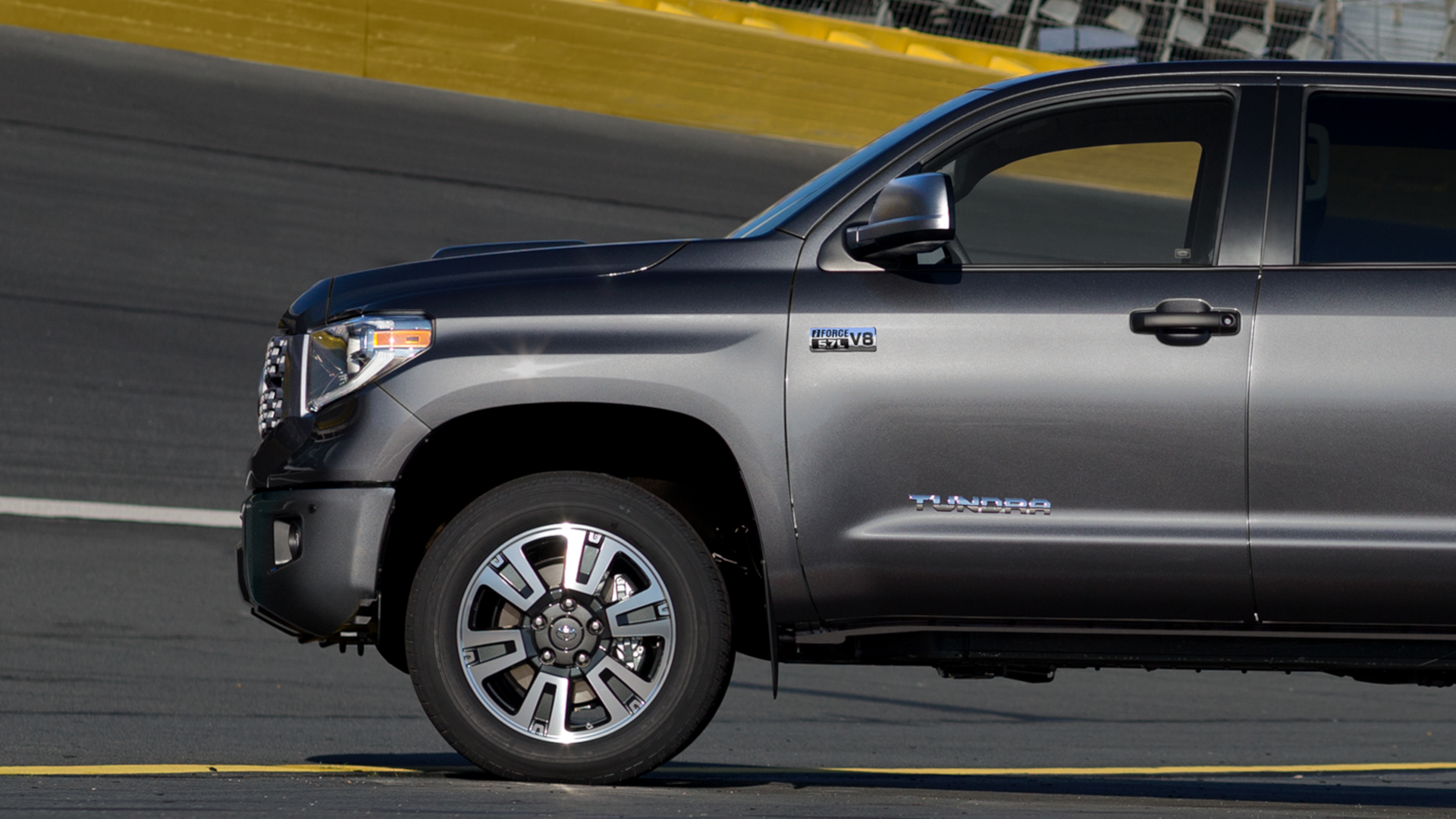
From V8 Power to Turbocharged Efficiency
If you’re debating between a highly-proven second-generation Toyota Tundra and the all-new third-generation machine for your pickup truck dollars, you’re in the right place. In its day, a big-displacement V8 helped the Tundra take the fight to competitors like the F-150 and Sierra. The new Tundra is smarter and more powerful, having ditched the V8 engine in pursuit of more power and lower fuel costs. Still, the previous-generation, V8-powered models have earned a solid reputation as one of the most dependable pickups on the road.

- Base Trim Engine
-
5.7L V8 Gas
- Base Trim Transmission
-
6-Speed Automatic
- Base Trim Drivetrain
-
Rear-Wheel Drive
Beneath the skin of the final Texas-built, V8-powered second-generation Tundras is a driveline and platform with 14 years of continuous production experience and improvements built in. Below, we’ll dive into the final years of the V8-powered Toyota Tundra, and what you can expect to pay for one today.
Below, we’re focusing on the final run of V8-powered Toyota Tundras with the 5.7-liter engine. For used market pricing data, we’re focusing on the final two years of V8-powered Toyota Tundra production, though the images and information below apply more broadly to the entire second-generation Tundra, which debuted in 2007.
Now Deceased: The Toyota Tundra Had Two Great V8s Under Its Belt
Is the Toyota Tundra better with a V8? Let’s start with a little context. Pickup truck shoppers shop for pickup trucks for a multitude of different reasons. Hybrid-powered compact options like the Ford Maverick and segment-benders like the Honda Ridgeline and Hyundai Santa Cruz demonstrate that the marketplace loves selection, with some preferring to drive the latest-and-greatest model with the most advanced tech and features of the day. Others prefer the convenience and refinement of an all-electric. Some shoppers would never drive a four-cylinder pickup as a matter of principle, though Ford sells loads of them.
For other shoppers, it’s less about MPGs and power output, and more about proven dependability, easy serviceability, and owning a machine that’s time-tested and easy to care for. If you’re one of these, you’ve probably heard of the Tacoma and Tundra: two Toyota pickups whose previous-generation models famously sold for many, many years with virtually no changes or updates. This “leave well enough alone” approach earned previous-generation Tundra and previous-generation Tacoma models homes in many driveways.

Related
Which Toyota Hybrid Truck Works Harder For Your Gas Dollars?
On the fence between these hybrid trucks? Start with this math.
The first-generation Tundra laid the foundation for future successes and built plenty of brand recognition around the nameplate. The optional 4.7-liter V8 engine offered 245 horsepower and was the first 32-valve, DOHC V8 engine in the full-sized truck segment of the day– as well as the first in the segment to earn the Low Emission Vehicle (LEV) classification from the EPA. With the 4.7-liter V8, Toyota was flexing some engineering muscle, with the LEV classification helping cement the brand’s reputation for fuel-efficient vehicles.
The competition was tough, and by the time the second-generation Tundra rolled out for 2007, a great big V8 engine was basically a requirement to play in the increasingly fierce pickup truck market, though Ford would be launching EcoBoost V6 engines in the F-150 a few years later.
Toyota’s latest V8 engine for the second-generation 2007 Tundra had a displacement highly familiar in the 4×4 scene: 5.7 liters. It originally sold alongside a revised 4.6-liter V8 (slightly downsized with some tweaks in a refresh) and 4-liter V6. Eventually, those smaller engine options were discontinued as the new V8 soldiered on as the only option under the Tundra’s hood by the end of this generation’s life. An aluminum 5.7-liter unit from Toyota’s UR engine family, it used conventional port fuel injection and 32 variable valves to generate 381 horsepower and 401 lb-ft of torque. Attached? A proven six-speed automatic that carried on for years after competitors had switched to more complex 7-, 8- and 10-speed boxes. Surrounding it all? A platform and construction that would remain largely untouched for the next 14 years.
Though its official time of death is unclear, it’s likely the last V8-powered Toyota Tundra rolled off the assembly line on a warm spring day in early 2021.
The Tundra’s Last V8 Versus Its Potent New Replacement, With Less Displacement
There are pros and cons to both the Tundra’s former V8 engine and the new twin-turbo V6 that replaced it. The new 3.4-liter twin-turbo V6 from the new V35A engine family is smaller and has two fewer cylinders, but a pair of turbochargers with liquid-to-air intercoolers allow it to make 20 percent more torque a full 1,200 RPM earlier than the previous V8 – all while using 25 percent less gas. According to the EPA, that’s a $1,100 annual saving versus the old V8. Though we’re focusing on the standard version of the new Tundra’s V6 engine mentioned above, shoppers can optionally step up to a hybrid-assisted version of the twin-turbo V6.
|
Key Specifications |
||
|---|---|---|
|
Model |
2021 Toyota Tundra 4×4 |
2022 Toyota Tundra 4×4 |
|
Engine |
5.7-liter NA V8 gas |
3.4-liter V6 gas twin turbo |
|
Power |
381 hp |
389 hp |
|
Torque |
401 lb-ft @ 3,600 RPM |
479 lb-ft @ 2,400 RPM |
|
Transmission |
6-speed auto |
10-speed automatic |
|
Drive |
4×4 |
4×4 |
|
Towing Max |
10,200 lbs |
12,000 lbs |
|
EPA Annual Fuel Cost |
$3,400 (regular fuel) |
$2,500 (regular fuel) |
According to the EPA, that’s a savings of $1,100 per year. The big low-rev torque and smooth 10-speed automatic transmission help dial up refinement and response while keeping noise levels to a minimum. Still, the new turbo V6 engine wasn’t without its problems, and hundreds of thousands of models were recalled to be assessed for signs of manufacturing debris within the engine, which is fatal.

Related
Best V6 Trucks Of 2025
Do you really need that V8?
Here’s What You’ll Pay For a 2021 Toyota Tundra Today
If you figure sticking with the trusty old V8 engine might be the way to go, here’s a look at what you can expect to pay. We’re using data from Autotempest.com, and sticking to the final two model years of production for the second-generation Tundra (2020 and 2021), capitalizing on the model’s final facelift.
If you’re on a tighter budget and don’t mind a high odometer reading, you’ll find high-mileage units around the 200,000-mile mark in the $20,000 to $25,000 range. If you’re after something with lower mileage, $40,000 to $50,000 can land you in a unit with less than 20,000 miles. Note that the popular TRD PRO version was one of the Tundra’s most popular and pricey, and used units can push well past $50,000, often with higher miles.

Related
Toyota Tundra TRD Pro: Why It’s Toyota’s Toughest Full-Size Pickup
What makes the Tundra TRD Pro Toyota’s toughest truck?
To start your ownership experience off on the best foot possible, be sure you’re familiar with the maintenance requirements and servicing history of the second-hand Tundra you’re considering. If service records aren’t readily available, the seller can typically source them from their repair shop or dealership. Buying a model that’s familiar to the selling dealership and has been regularly serviced there can help add confidence and peace of mind.
Be sure to determine where you stand with the vehicle’s warranty, too. The previous owner may have added warranty coverage that is transferrable to you, so be sure to ask for relevant documentation if applicable. Quality and Reliability scoring from JD Power is patchy throughout the Tundra’s second generation, though all model years with a score earned a “GREAT” rating – including the V8 Tundra’s last: 2021.
Sources: Toyota, JD Power, EPA, Autotempest