
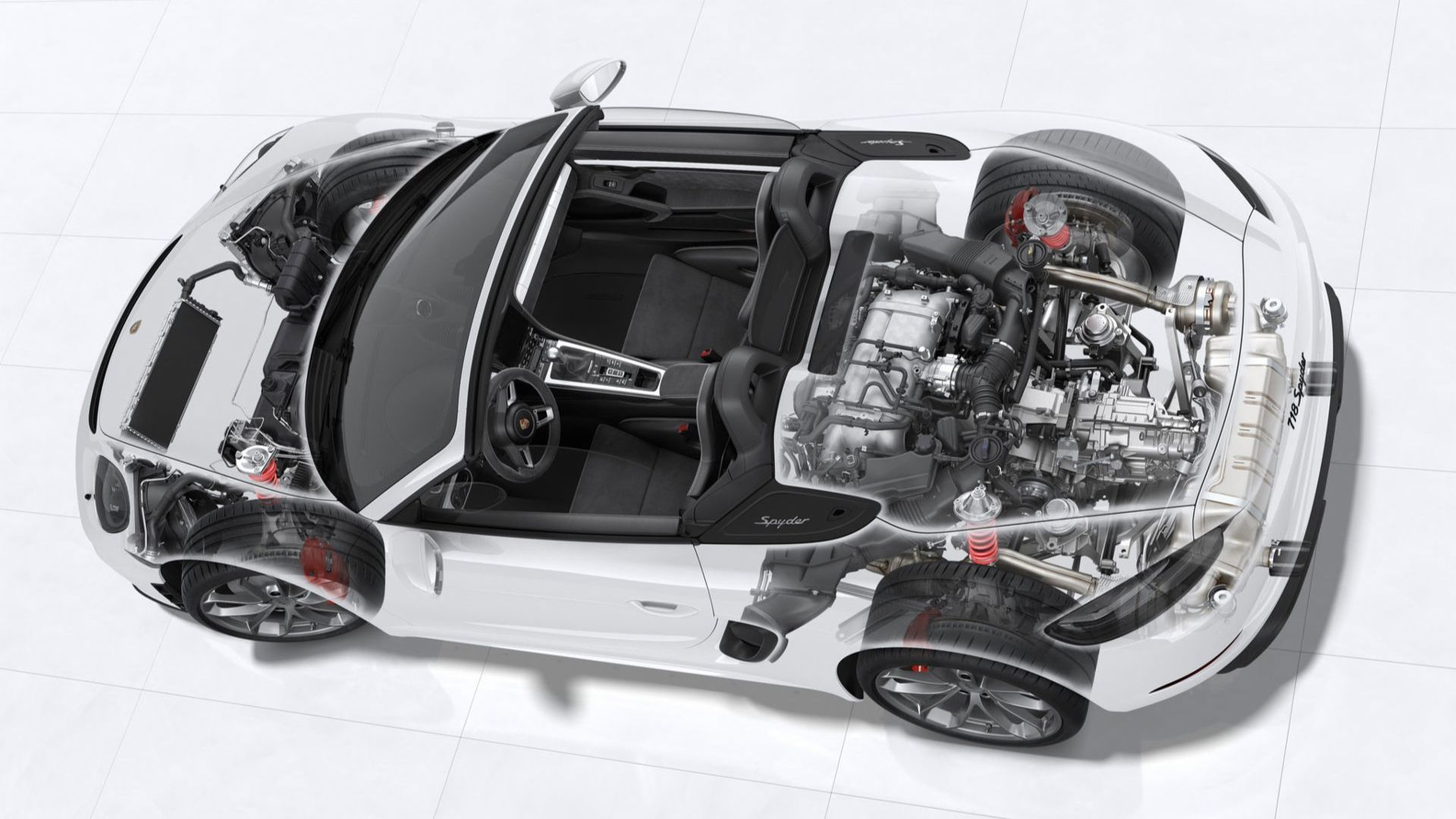
Handling Differences: Front-Engine Vs. Mid-Engine Cars
Many supercars have a mid-engine configuration, though many mid-engine cars are not supercars. Just where does the engine in a car belong, anyway? Carmakers including Porsche, Ferrari and Toyota (as well as many, many others) have been experimenting with that question for ages. If you’ve found yourself in a position to decide whether a front or mid-engine might be best for your next car, we’ll cover some thoughts and facts to guide your decision, below.
-
Toyota
Toyota is a Japanese automaker founded in 1937 that has developed a reputation for reliability across a multitude of segments, from sports cars and family sedans to pickup trucks and off-roaders. Famous models from the brand include the Hilux, Land Cruiser, Camry, Crown, and Corolla, the latter being the world’s best-selling vehicle nameplate, with more than 50 million Corolla-badged vehicles being sold since it was first introduced. Toyota typically competes in the mainstream market, but is also famous for launching Lexus as a luxury sub-brand to take on Mercedes-Benz.
-
Porsche
Porsche is a German sports car manufacturer and part of the broader Volkswagen Group since August 2012. Founded in 1931 by Ferdinand Porsche, the brand is most famous for the 911 line of sports cars, which first launched in September 1963. But it was the Porsche 356 that came first, and subsequently, Porsche has expanded its model lineup to include a variety of sports cars, supercars, SUVs, sedans, and even EVs. Porsche has a rich history in motorsport, with 19 outright Le Mans victories to its name, among various other titles.
-

Ferrari
Ferrari is an Italian manufacturer of sports cars, supercars, and luxury grand tourers founded by and named after Enzo Ferrari in 1939 – originally as Auto Avio Costruzioni due to legal complications with Alfa Romeo. Ferrari famously only produced roadgoing sports cars as a means of funding its racing exploits, which include multiple F1 World Championships and wins at Le Mans and various other prestigious races. Today, Ferrari is one of the most valuable brand names in the world, limiting production of its highly-sought-after models to maintain desirability, which is in no short supply when they’re powered by some of the world’s most advanced V6, V8, and V12 engines.


Most cars keep their engines up front because that’s convenient, easy to mass produce, and good enough for some of the most capable vehicles on the road. But is it better to put the engine in the middle? Some of the world’s fastest cars do it that way, and you usually get two trunks as an added bonus (though usually at the expense of a back seat). Whether you’re considering a Corvette C8, Toyota MR2, Porsche Cayman or Pontiac Fiero or an Audi R8, here are some of the main differences you can expect between mid-engine and front-engine cars, and their impact on your daily life.
For this feature, we’re focusing on relatively affordable mid-engine sports cars over the past few decades.
Mid-Engine Cars in Day-to-Day Driving
Popular Mid-Engine Cars
- Toyota MR2
- Chevrolet Corvette C8
- Acura NSX
- Renault Clio V6
- Smart Roadster
- Honda Beat
- Porsche Cayman
- Lotus Emira
When you first make the switch from a front-engine sports car to a mid-engine sports car, you’ll likely notice that things feel a little different, but that there’s ultimately not much new to get used to. You’ll get in, get seated, start the engine and shift into gear, but the engine starter noise will come from behind you, low in the car, instead of up front.
You may notice an improvement in visibility, too– especially in certain models. For instance, a front-engine Dodge Viper has a long hood, and seats almost on top of the rear axle. Occupants sit deep in the cabin, and outward sightlines are poor. This can make driving less relaxing and more stressful.
A Corvette C8, conversely, seats occupants up towards the front of the car, with less hood and more open space visible ahead. The mid-engine shape means more optimally-shaped windows, which means better outward visibility and can result in lower-stress driving. Rear visibility can be a problem, however, but that’s what side mirrors are for.

Related
This Mid-Engine Sports Car With Toyota Reliability Is A Steal In 2025
Think you can’t afford a mid-engine sports car? Think again. And this one packs one of the most reliable V6s ever built.
Cars are shaped in no small part based on where their engines are located. In a mid-engine car, a more forward windshield and driving position, with the driver sitting further up ahead in the car’s body, can make it easier to see the world around you. The mid-engine Pagani Zonda, when viewed from the side, is an extreme example of this. When test-driving the cars you’re considering, whether front or mid-engine, take careful note of the outward visibility of each.
Elsewhere in your day-to-day mid-engine driving, things are pretty normal. When filling up with gas, it may take a few visits to the pumps to get used to the location of the fuel-filler opening, which may be positioned on a front fender or somewhere unfamiliar, depending on the model. That new-to-you mid-engine car will likely have a frunk and a trunk, giving you two places to store cargo or keep groceries and gym gear separated. Remember: the rear trunk of your mid-engine car (if equipped) can become toasty warm inside since it’s near the engine. The Lotus Emira, for example, kept on melting our chocolates.

Related
Chevrolet Reveals $2,000 Accessory For The Corvette Owner Who Can’t Stop Showing Off
If you need every part of your C8 Corvette to be branded, Chevrolet Performance has two new parts that will help you get there.
For maintenance and fluid checks, you’ll need to access dipsticks and filler caps from the rear of the car. Some mid-engine cars have their engines visible and accessible from up top, including the Audi R8, Toyota MR2 and Corvette C8. Others, like the Porsche Cayman, have engines covered away and not accessible from up top, other than via a small panel that opens for access to oil and coolant fill. Mid-engine cars commonly keep their battery, or battery terminal hookups, in the frunk.
When it comes to day-to-day driving, mid-engine cars can make a lot of situations more entertaining. Around town, roundabouts and on-ramps become particularly more enjoyable, since the front end of a mid-engine car is light, doesn’t have a heavy engine on top of its wheels, and responds more quickly to your inputs and typically with minimal work at the wheel. Winding through traffic, ramps, corners and roadways feels light and effortless by comparison, more of an extension of the driver’s body.
Finally, note that most mid-engine cars on this side of an affordable pricetag are light and aerodynamic by nature, making them relatively easy on fuel despite often considerable power output.
Track Day: It’s Something Different, And Instructors Love it
|
2024 Porsche Cayman |
2024 Chevrolet Corvette C8 |
|
|
Base MSRP |
$68,300 |
$68,300 |
|
Engine |
2.0L Turbo Flat 4 |
6.2L V8 |
|
Transmission |
6-MT |
8-DCT |
|
Horsepower |
300 |
490 |
|
Torque |
280 lb-ft |
465 lb-ft |
|
Drivetrain |
Mid-engine, rear-drive |
Mid-engine, rear-drive |
If you take your mid-engine Lamborghini, Cayman or Corvette C8 to an instructed track day, you’re in for a good time. Instructors love teaching mid-engine students, and many track-day instructors drive or race mid-engine cars themselves, often Porsche Caymans. Many weekend track schools will usually have a few mid-engine experts you can take advantage of.
On good tires with a proper instructor and experience, you’ll feel more confident powering out of corners, even with 2WD and plenty of power, as the rear end is typically more planted and confidence-inspiring, especially in high-powered applications. With a powerful engine up front and two driven wheels in the rear, the tail of the front-engine car needs to be handled more carefully and cautiously to put down maximum power. In a mid-engine car, with the weight of the engine sitting much closer to the rear wheels, there’s an inherent traction advantage. With lessons and practice, you’ll learn how to work the mid-engine balance in your favor.

Related
The Top 10 Used Performance Cars for Track Days
Thinking of buying a car for demanding track days. These are ten perfect performance cars that will get the job done.
All the while, steering is typically less labor-intensive and requires smaller inputs, which can reduce driver bandwidth demands and improve focus. All around, weight transfer tends to feel less dramatic too, and that’s more comfortable even at speed. The car feels easier on its (novice) track day driver, and likely explains why the Porsche Cayman is such a popular sight at weekend events: compared to a bigger power front engine car, there’s less wrestling at the steering, meaning you can feel more through your arms and fingers since your muscles are less tense, more of the time.
Get to pushing your car a little, and the 50:50 weight balance and neutral handling characteristics of mid-engine cars come into play. Though your results will vary, mid-engine cars tend to neither understeer nor oversteer when pushed, meaning they’re less stressful and more predictable to drive fast. Sure, any car will understeer or oversteer when given the correct set of instructions, but an experienced mid-engine driver doing a hot lap is likely to feel little of either.
Physics Lesson
|
Model |
2024 Porsche Cayman |
2024 Chevrolet Corvette C8 |
|---|---|---|
|
Base MSRP |
$68,300 |
$68,300 |
|
Engine |
2.0L Turbo Flat 4 |
6.2L V8 |
|
Transmission |
6-MT |
8-DCT |
|
Horsepower |
300 |
490 |
|
Torque |
280 lb-ft |
465 lb-ft |
|
Drivetrain |
Mid-engine, rear-drive |
Mid-engine, rear-drive |
The mid-engine car feels especially spritely and lively, whether driven fast on a racetrack or spiritedly in day-to-day driving. Largely, that’s because of the same principles that you may have learned in high school physics.
Imagine using your finger to rotate a record that’s sitting still on a turntable with a small but heavy weight on its surface. With the weight towards the outside of the record, it’ll take more effort to begin rotating the record. Move the weight towards the center of the record, and it’ll be easier to rotate on the turntable. This is, roughly, the principle of moment of inertia, which describes a resistance to rotational changes. When the weight on our record is near the middle, the moment of inertia is lower, and the record is easier to rotate.
When the weight is near the outside of the record, the record is harder to rotate. This same principle applies to cars: the more weight concentrated in the middle, the easier it is to rotate. The more weight concentrated at the front, the harder it is to rotate.
The nutshell? Pull as much of the car’s weight towards its center, and you make it much easier to change directions.
Mid-Engine In The Snow
Interesting Facts About Mid-Engine Cars
- Front engine cars have a big grille opening just ahead of their engines, helping air flow through the engine compartment. Mid-engine cars don’t have access to this airflow, meaning they often have additional venting built into the side fenders behind the doors, or underneath. This extra venting ensures proper airflow through the engine compartment and heat exchangers if applicable.
- Look closely at the C8 Corvette, and you’ll spot the air intakes on each side, as well as vents alongside the rear glass that let heat escape. While driving, this works to help flush excess heat out of the engine compartment.
- Mid-engine cars often have a radiator up front, and extra-long coolant lines connecting them to the engine in the middle. This extra plumbing can cause gurgling and burping noises from your mid-engine vehicle’s cooling system for hours after it’s turned off, especially in older models. Usually, these noises are normal, but your owner’s manual has the full scoop.
Mid-engine cars can be a real joy to drive in the snow, though you’ll notice a few changes to how the car responds, which can mean reapproaching certain aspects of driving when traction is low. Like anything, there are pros and cons at play. When accelerating on snow and ice, a rear-drive mid-engine car can outperform a rear-drive, front-engine car when it comes to launch traction, since more of the vehicle’s weight is sitting closer to its driven wheels. Proper tires are a must.
When steering and / or braking on slippery surfaces, some mid-engine cars can tend to understeer or respond poorly to steering inputs in certain situations. Specifically, without the weight of an engine over the front wheels, some drivers may find a mid-engine car to feel ‘too light in the front’ on snow and ice. With proper tires, an experienced driver and modern assistance, this is hardly an issue. Still, mid-engine drivers can practice braking earlier and staying on their brakes longer while steering on snow and ice to help effect a weight transfer to the front axle to help it bite harder when the going gets greasy.

Related
10 Winter Driving Myths Debunked
You think you know how to handle winter weather, but are you falling victim to winter driving myths that you should be kicking to the curb?
With proper tires, a mid-engine car can be an excellent winter driver. Handling, being neutral, tends to be notably more stable– with the car preferring to neither fishtail nor understeer when driven smoothly in the hands of a competent winter driver. It’s a side-benefit of moving all the weight to the middle: not only does this make the mid-engine car easier to steer, but it also tends to make it feel more stable and planted beneath you, which translates well into winter driving confidence.