
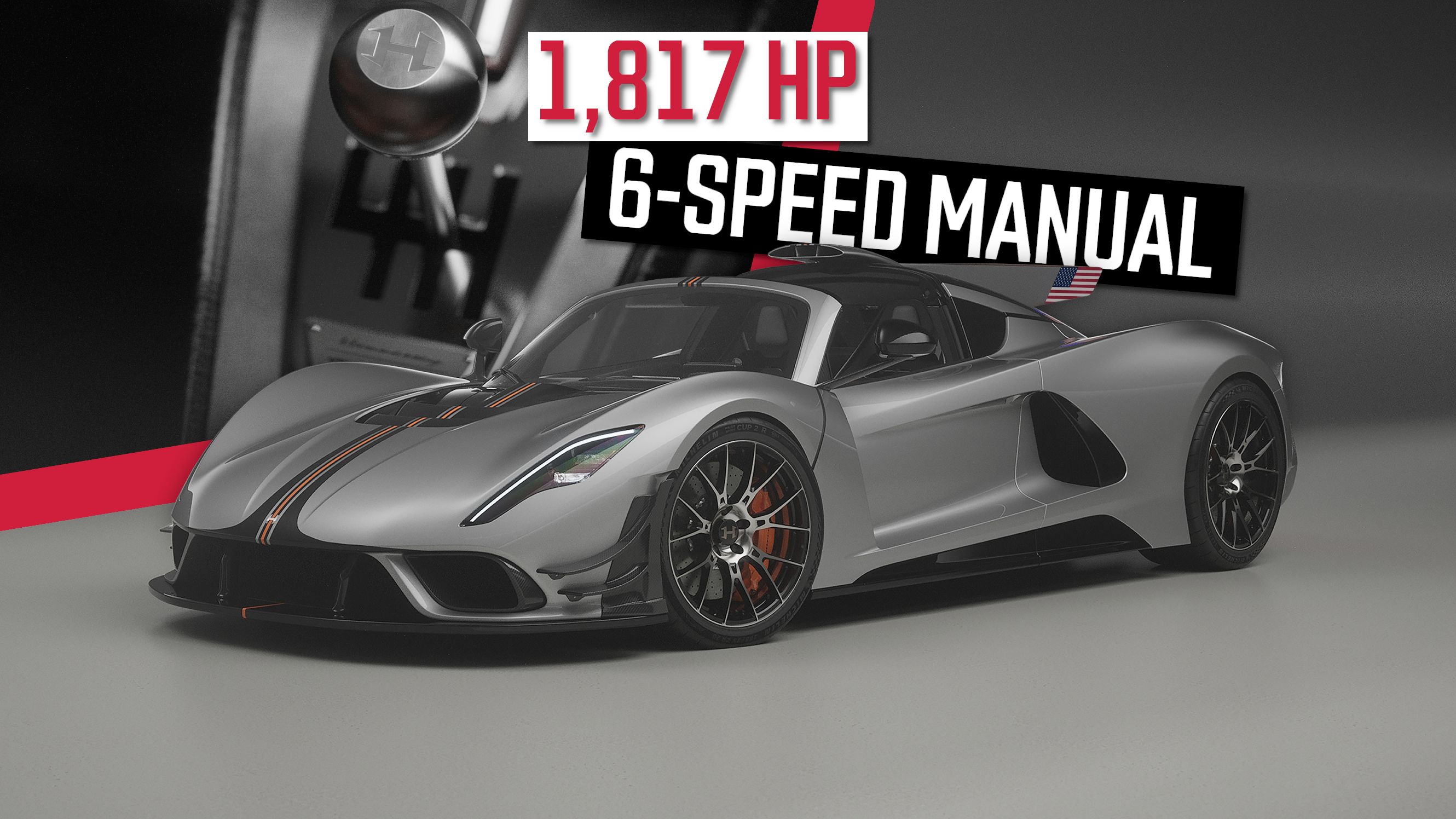
Hennessey Venom F5-M Roadster Is The World’s Most Powerful Manual-Equipped Car Ever
Key Takeaways
- Hennessey Venom F5-M is the world’s most powerful and fastest manual car.
- 6.6-liter twin-turbo Fury V8 develops 1,817 horsepower and 1,193 lb-ft of torque, paired to a six-speed manual gearbox.
- Limited to 12 units, in Roadster configuration only, all sold out.
Hennessey has unveiled the world’s most powerful production car to feature a manual gearbox, equipping a six-speed manual with a gated shifter to the Venom F5 Roadster to create a new variant called the Venom F5-M. And this isn’t a simulated manual like you’ll find in the Koenigsegg CC850; no, this is a genuine gated manual developed by Hennessey in partnership with CIMA and a project that required extensive redevelopment of the Venom F5’s carbon fiber monocoque chassis to accommodate the mechanical linkage and pedal box for the manual transmission.
Limited to just 12 units, forming part of the 30-unit Roadster allocation of the Venom F5, the Venom F5-M is already sold out at launch, with customers coughing up $2.65 million for the privilege (before options and customization, of which there is plenty).
Hennessey currently holds the record for the world’s fastest manual-equipped convertible vehicle, with the
Venom GT Spyder reaching 265.57 mph
on March 25, 2016. Hennessey insiders suggest that “knowing John Hennessey, whether or not [top speed] figures have been determined, he probably isn’t going to want to leave that on the table with his new car.”
Mechanical Changes: More Than Just A New Gearbox
At its core, this is the same Venom F5 Roadster we know and love, powered by a twin-turbocharged 6.6-liter ‘Fury’ V8 engine producing 1,817 horsepower and 1,193 lb-ft of torque. But the carbon fiber tub had to be adjusted, not just to accommodate a mechanical linkage down the transmission tunnel, but also to accommodate a third pedal and its accompanying mechanisms. Beyond that, the transmission tunnel had to be raised to accommodate the shifter being mounted in the ideal position for interaction between the driver and the car, with resulting changes to the interior design, like the HVAC vents now being mounted side-by-side instead of one above the other.
“We are so excited to offer the Venom F5-M Roadster – the world’s most powerful manual. We always wanted to build a manual Venom F5 – and it’s something our clients have been asking for. It’s old school, it’s badass, and it offers ultimate driving engagement.”
– John Hennessey, Hennessey Founder and CEO
Hennessey hasn’t quoted performance figures for the Venom F5-M, because that’s not what this car is about. This is about engaging with the beast, creating, as Mr. Hennessey puts it, “the most intense, immersive, and extreme driving experience on the planet.”
Add CarBuzz to your Google News feed.
The engine itself may retain the same outputs as the standard car, but it will be remapped to provide a driving experience suited to the six ratios of the Venom F5-M compared to the seven of the standard car. You also won’t have access to the full 1,817 hp in lower gears – something Hennessey has already done in the standard car. According to Hennessey Design Director Nathan Malinick, “If you got all of that power in first gear, you’d just be going in circles constantly […] In the paddle-shift car, you really can just mash the throttle and go and it just hooks up, and so that’s what we’re expecting for this car as well.”
A Year To Refine The Recipe Before Customer Cars Arrive
The car you see today is a digital render of what to expect, but over the next year, Hennessey head of engineering Brian Jones and his team will refine all the elements into one cohesive package. “You may be able to catch a glimpse of a development car running around Houston, Texas, this fall and certainly into next year,” we’re told, which will be part of making sure the manual gearbox makes this an engaging experience rather than a deadly one.
Hennessey Refuses To Do Synthetic Anything
Speaking to CarBuzz ahead of the unveiling of the Venom F5-M, Malinick told us that Hennessey doesn’t believe in doing anything synthetic. “Any material that you touch, if it’s carbon, you know, it’s actually carbon. If it looks like it’s metal, it’s actually metal,” explains Malinick, “and so to have that interface with man and machine, with that physical linkage, was really, really important for us.”

The gearbox was designed specifically for Hennessey, produced by Italian outfit CIMA, the same company supplying the manual gearbox for the NILU hypercar. This is a supplier that knows how important a tactile H-pattern shifter needs to be, but Hennessey wanted to ensure every aspect was up to scratch, from the materials used to the positioning of every touch point. According to Malinick, the shifter isn’t just a metal knob, “it’s a mix of metal and carbon fiber.” He explains that “to have every single touchpoint be supreme in quality, feel, and action, was crucial for us.”
That’s why the shifter is raised to optimize the sense of connection, reducing the distance it takes to move your hand from the steering wheel to the shift lever and back. “It’s all about having just the best driving experience that we can offer, that the world has to offer,” says Malinick, “and so when we were benchmarking other amazing manual cars in years gone by, it just became obvious that we needed to elevate the gear knob up a little higher to the steering wheel. And so that’s why we did that.”

Venom F5-M Manual Fun Fact
Hennessey’s first roadgoing car, the Venom GT, was built on the basis of a Lotus Elise. Lotus founder Colin Chapman famously believed that the perfect placement of a manual shifter should be no further from the wheel than the distance between your outstretched thumb and pinky finger. By lifting the shifter closer to the wheel, Hennessey has inadvertently retained a similar philosophy to the man behind Lotus, without whom there would be no Venom GT.
Design Elements Exclusive To The Manual
While the mechanical changes aren’t visible unless you take a closer look at the cabin, there are still visual cues that are exclusive to the F5-M. The biggest of those is the 55-inch-long stabilizer fin on the rear of the car, which runs down the center spine and is both stylish and functional, adding a layer of stability at speed when you take one hand off the wheel to shift gears.
“We’re a design-led and driven company, and we know that how our customers and our fans first interact with our vehicles is with their eyes, so the impact of the beauty of the car itself is supremely important to us. With that said, all of those things are meaningless if it doesn’t actually work, right?”
– Nathan Malinick, Hennessey Special Vehicles Design Director
Other elements were also tweaked for visual impact and mechanical improvements, like the roof scoop, which Malinick tells us was elongated to channel more air to the Fury V8 engine, but also features the “F5 Fangs,” two vertical struts that emulate a similar element in the car’s front fascia.
A Unique Motorsport-Inspired Livery
While every Venom F5 is customized to the unique requests of each customer, Hennessey saw fit to design a special livery exclusive to the Venom F5-M, something Malinick admits he “would like for every car to have.”
The inspiration for it came from classic Le Mans racers of the 1960s, with a colored front end curving up into a central stripe detail. For the Venom F5-M, the curved detail is exposed carbon fiber, with a trio of stripes, the two outboard items being matched to the rest of the body, while the central one is color-coded – here shown in orange and running the length of the car, from the front splitter, right over the top of the stabilizer fin, and down to the rear splitter.
It even continues into the cabin of the car, where the rear bulkhead – something Hennessey internally refers to as the ‘rear waterfall’ – has a painted stripe to match; this is the first time Hennessey has introduced paint into the cabin of the F5. And as Malinick puts it, because Hennessey is “very proud of our American heritage, we had to put the American flag on the fin as well.”
The artistry is in the details, though, and if you were to run a finger over the nose of the car, where the finish goes from paint to carbon to painted stripes, with the Hennessey H logo on top, you wouldn’t be able to feel a change in surface. “If you were to run your finger over all four levels, over multiple different materials, it would be completely smooth,” says Malinick. “And that is extremely, extremely difficult to achieve. We’re very proud of it.”