
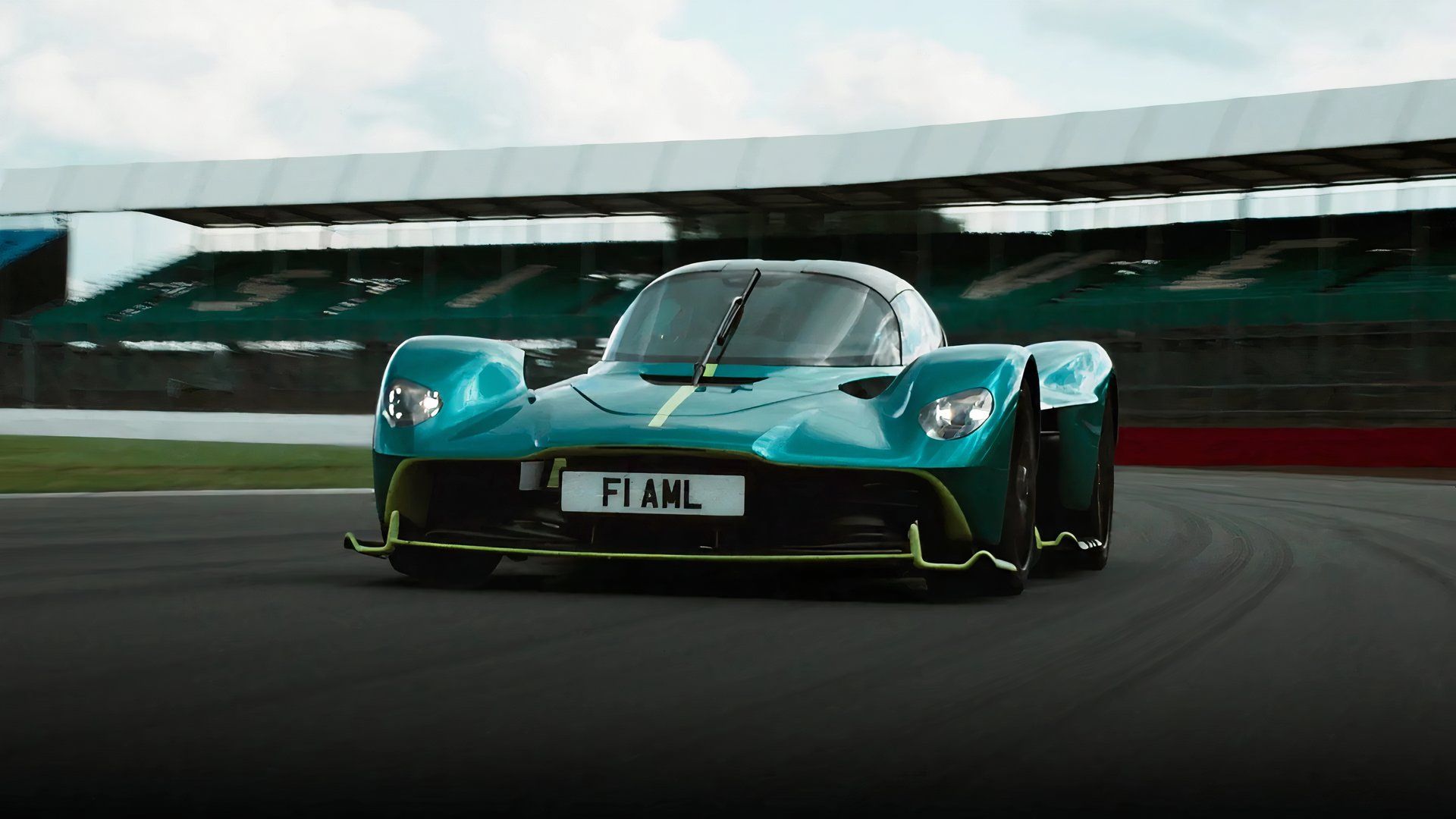
How Aston Martin Demonstrated The Difference Between Hypercars And F1 Racers
Aston Martin has carved out a commanding reputation as being the gentleman’s performance brand since its inception in the early 20th century. This attachment was further emphasized by its models being synonymous with the fictional suave British spy called James Bond, with cars like the DB5 and the DBS becoming iconic in their respective appearances in the film series.
It also knows its way around a track though, as evidenced by its multitude of class and one overall victory at the fabled 24 Hours of Le Mans, among other contests. It also currently competes as a manufacturer in Formula 1, which sees the most technologically advanced cars in the world go head-to-head around some of the world’s best tracks. The speed of the cars is made all the more clear by Aston’s rapid Valkyrie road car, which recently shattered the production car lap record at Silverstone.
The Valkyrie Is Truly A Track Racer Repurposed For The Road
The Valkyrie first broke ground as a concept in 2016, and was designed in a partnership between Aston Martin and Red Bull Technologies, an off-shoot of the energy drink brand’s F1 team and which has recently revealed a hypercar of its own. Aston acted as its title sponsor at the time, and the two parties wanted to pen a road-legal track car that featured money-can’t-buy expertise from one of history’s most decorated F1 designers, Adrian Newey.
Given Newey’s F1 experience as an aerodynamicist, it should come as little surprise that a key aspect of the Valkyrie’s design was producing the most downforce possible. To achieve this, it was given a flat floor to help create ground effect, with the front splitter and rear diffuser helping to make use of the air directed underneath the vehicle. Due to its reliance on ground effect to create downforce, the Valkyrie only needed a relatively understated rear wing. The Valkyrie’s floor produces 1,800 kg of downforce, ensuring it can attack corners at rapid speed, which is the very reason why F1 is so much faster than any other formula.
The Valkyrie Howls Like A Banshee
The thing is, to utilize all that downforce, you need to enter a corner with as much speed as possible. Aston got around this issue by combining a 6.5-liter Cosworth-built V12 engine with a 160-hp electric motor, making it a hybrid. The total power output is 1,140 hp, a total helped by the V12s eardrum-shattering 11,100 rpm. Along with its instance level of grunt, the Valkyrie’s all-carbon fiber body ensures it weighs just 2,987 pounds.
The power is sent to the rear wheels via a seven-speed semi-automatic gearbox. The result of all these headline additions was a car that could be driven to any circuit in the world via normal roads, before then bossing records without breaking a sweat.
The Valkyrie Shares Many Elements With Its F1 Cousin
|
Model |
2021 Aston Martin Valkyrie |
2024 Aston Martin AMR24 |
|---|---|---|
|
Engine |
6.5-liter V12 with hybrid |
Turbocharged 1.6-liter V6 with hybrid |
|
Power |
1,140 hp |
1,000 hp est. |
|
Torque |
664 lb-ft |
N/A |
|
0-60 mph |
2.5 seconds |
1.6 seconds |
|
Weight |
2,987 pounds |
1,750 pounds |
|
Downforce |
1,800 kg |
2,500-3,000 kg |
The Valkyrie was actually a radical departure away from the F1 cars pounding around tracks when it was first conceived, mainly due to its reliance on ground effect, which is becoming more prevalent in normal road cars. F1 cars of the time used complicated front and rear wings to create the bulk of their downforce. For 2022, though, the rules changed so that F1 cars made the bulk of their downforce via their complicated floors, with wing downforce being utilized less in an effort to improve racing by reducing dirty air.
This made F1 cars and the Valkyrie nearly identical in terms of philosophy, especially as both featured hybrid powertrains. The Valkyrie also has a KERS system, which can be used to boost power in short bursts by using more energy from the battery. F1 car systems can’t be used separately anymore, as they work automatically with the rest of the system. The Valkyrie also uses a similar exhaust setup to its F1 cousin, as they exit from the top of the car rather than the side or rear like most road cars.
The F1 Is More Extreme In Every Way
While the Valkyrie shares some interesting elements with an F1 car, they are in different leagues from a performance perspective. While the Valkyrie is built to be usable on the road, the F1 car is built purely to clock the fastest lap time possible. As a result, the aero package on the F1 allows it to create well over twice the downforce of the Valkyrie, while its lightweight construction ensures it weighs just 1,750 pounds.

Related
The One-Off Aston Martin Microcar We Wish Would Go Into Production
We know it will never happen, but here’s why we want Aston Martin to push this ridiculous one-off microcar into production.
While the Valkyrie gets a V12 main course alongside its hybrid, the F1 car has a turbocharged 1.6-liter V6. Total output for the F1 racer is lower at around 1,000 hp, though its lower weight figure and extra downforce more than make up for the shortfall. It also has more powerful carbon ceramic brakes than the Valkyrie, which are made from the same material. The F1 car also gets huge and sticky Pirelli slick race tires, while the Valkyrie uses road-spec Michelin Pilot Sport Cup 2 tires.

Add CarBuzz to your Google News feed.
The F1 Car Has The Valkyrie Licked Around A Track
|
Silverstone GP Laptimes |
|
|---|---|
|
Aston Martin AMR24 |
1:26.58s |
|
Aston Martin Valkyrie |
1:56.42s |
|
Modified Porsche 911 GT2 RS |
2:06.83s |
|
Lamborghini Murcielago LP670-4 SV |
2:08.10s |
The difference between a track-focussed road car and a hardened F1 car is clearly illustrated by the difference in lap times between the two vehicles at Silverstone. While the Valkyrie’s 1:56 effort is hugely impressive, and well ahead of any other production car around the 3.6-mile circuit, it can’t hold a candle to the F1 car’s effort. Aston’s AMR24 managed a fastest lap time of 1:26.585s during qualifying for the British Grand Prix in July 2024, with Lance Stroll at the wheel.
This puts it a full 30 seconds quicker than the Valkyrie, showing the true difference between a road car and a fighter jet on wheels. The F1 car is faster everywhere, with its sticky Pirelli slicks and lightweight body ensuring it can accelerate from corners faster and get down the straights quicker than the Valkyrie, despite the latter’s power advantage. These elements ensure it can also brake later and carry more corner speed than the Valkyrie on its own, let alone the huge amount of extra downforce.
Should both cars have been on the same tires, the lap time difference would be significantly closer. The Valkyrie also lapped the track when it had less grip, due to a rain shower having washed away any leftover rubber which gripped up the racing line, the night before. The F1 car posted its time in the final session of qualifying, where lots of rubber had already been laid on the racing line.
The Valkyrie Has Become A Racer In Its Own Right
Alongside the road-going version of the Valkyrie, a race version was planned to compete in the hypercar class of the World Endurance Championship back in 2020. After Aston was taken over by businessman Lawrence Stroll, who brought the brand into F1, these plans were scrapped. Following more evaluation time, though, the decision was taken to re-ignite the project and enter the WEC and the American-based IMSA series with the race version of the car from 2025.
The vehicle has completed an extensive testing program at a variety of tracks, and is currently on course to make its competition debut in either January’s 24 Hours of Daytona or February’s Qatar 1812 km contest. While featuring many similarities with its road-going counterpart, the LMH version will use a non-hybrid version of the Cosworth V12. It will also become the only LMH vehicle to feature chassis and engine developed from a road car, making it unique from its competitors.
Sources:
Aston Martin