
Is This Western European Luxury Sedan The Rarest Hyundai Ever Produced?
The international automotive market is weird. You’re always reading about automakers developing cars for other countries and then not even selling them in their nations of origin, or rebadging a car under a hundred different names all over the world. For instance, did you know that Lexus wasn’t even sold in Japan early on? Toyota developed the luxury offshoot to sell cars in America. The JDM market got the Toyota Celsior instead of the LS, so Japanese drivers wound up with a rebadged version of a Japanese car.

- Base Trim Engine
-
4.6L V8 Gas
- Base Trim Transmission
-
6-Speed Automatic
- Base Trim Drivetrain
-
Rear-Wheel Drive
- Base Trim Horsepower
-
378 hp
- Base Trim Torque
-
324 lb-ft @ 3500 rpm
The Hyundai Equus is one of those cars that’s been sold under several names across multiple automakers depending on where you’re driving it. Here in the US, we didn’t even get the first-gen version of this car, even while the Middle East got their own specialized version of the luxury sedan, known as the Hyundai Centennial, and Western Europe got an even rarer version under that nameplate. Here’s what you need to know about one of the world’s rarest production Hyundais.
The following is based on information published by Hyundai and Mitsubishi, as well as news articles and sales listings, cited as necessary. Any opinions offered herein are those of the author unless otherwise attributed.
We Never Got The Centennial, And We Never Got The V8 Engine Under Its Hood, Either
The thing about the first-gen Equus, it’s not just that it’s a luxury sedan that was never sold in the United States. You can’t throw a rock out a window without hitting one of those… unless you live in the United States. It’s the V8 engine under the hood of this car that makes us green with envy. This was the Mitsubishi 8A80, the only V8 engine Mitsubishi ever produced.

Related
The Mitsubishi Lancer Evo’s Twin You’ve Never Heard Of
The Mitsubishi Lancer Evolution is one of the most prolifc names in the Japanese automaker’s history, but few know about its twin, the Carisma GT.
We’ve already covered this engine in depth, so we’ll just give you the Cliff’s Notes here:
- The 8A80 was a 4.5-liter gas-powered NA, manufactured from 1999 to 2008.
- It could produce up to 276 horsepower and 304 lb-ft of torque.
- The 8A80 had a bore and stroke of 3.74 inches by 3.81 inches.
- It had a compression ratio of 10.7:1.
- The Mitsubishi Proudia and Dignity both featured 8A80 V8s.
We Want It Because We Can’t Have It
Sure, we’ve got plenty of powerful V8 engines to pick from these days that blow these specs out of the water, like the 5.0-liter Coyote available as a crate engine for vehicles like the F-150, delivering a whopping 400 horses. But so what? When you tell us that Mitsubishi made a V8, but we can’t have it, that just makes us want it more.
The Hyundai Centennial Was Mainly For The Middle Eastern Market
To get an idea of what, exactly, Hyundai changed between the Hyundai Equus and the Hyundai Centennial, let’s check the specs for the Korean and Middle Eastern versions of this car.
|
1999 Hyundai Equus |
1999 Hyundai Centennial |
|
|
Engine |
4.5-Liter NA 8A80 8-Cylinder |
|
|
Power |
270 hp |
|
|
Torque |
281 lb-ft |
|
|
Transmission |
5-Speed Automatic |
|
|
Drivetrain |
Front-Wheel Drive |
|
You know what else? Korea, the Middle East, and most Western European countries all feature the steering wheel on the left-hand side of the car, so they didn’t even have to change that. The Korean and Middle Eastern versions of the car even share the big, flashy hood ornament at the front of the car. Like the Toyota Celsior, this was one of those cars that was largely different in name.

Related
The V8 Hyundai Luxury Sedan That Thought It Could Play With The Mercedes S-Class
You probably don’t remember this luxurious Hyundai, but you should.
The Front Emblem Sets The European Version Apart
If you were to park a 1999 Centennial in a lot full of 1999 Equus sedans, you wouldn’t be able to identify the odd car out, unless it was European. This is because the European ones received a unique front emblem instead of a flashy hood ornament.
The European Centennials Are So Rare, We Could Only Find The Olympics Model For Sale
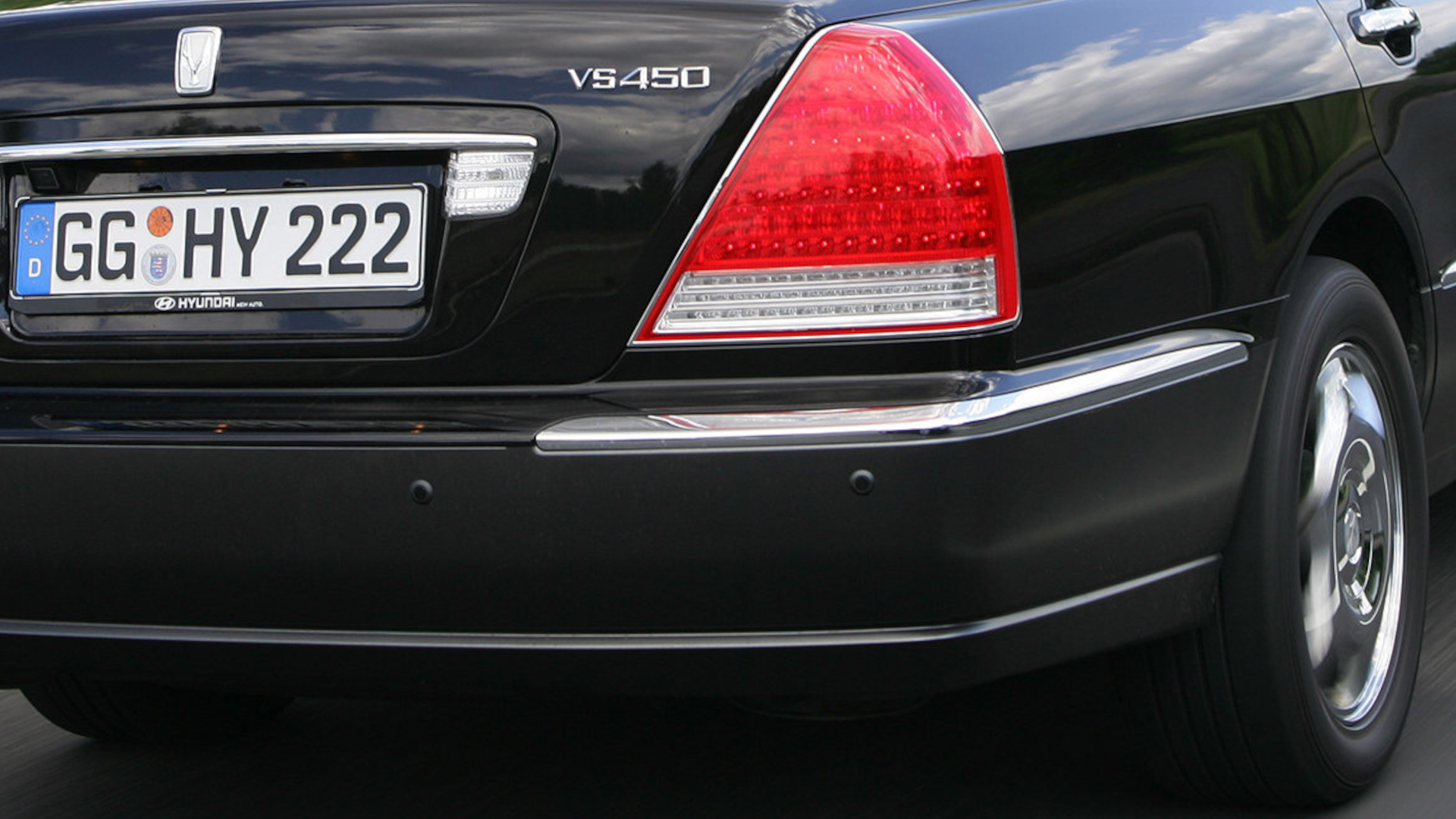
Some sources report that the Centennial was offered by Hyundai in limited numbers on the European market. If this is true, then the owners are keeping them under lock and key, because we could only find a single Western European Centennial on the used auto market, and that one belonged to the Athens 2004 Olympic Games. The car was supposedly driven around Greece by the President of the Organizing Committee, initially serving exclusively in an official capacity.

Related
Driven: 2025 Hyundai Elantra Hybrid Makes 50 MPG Cool
You no longer have to trade looking cool for stellar fuel economy.
If the seller’s story is to be believed, then this is the Centennial that was donated to the Olympic Games by Hyundai, and the missing hood ornament may have been a choice on the automaker’s part to set it apart from other models. If you take a look in the cabin, that story does seem to check out, because this is exactly the kind of luxurious interior we’d send along to impress Olympic Games VIPs and make a good impression on our European neighbors, decked out in all that beautiful wood grain.
A couple of years later, Hyundai would end up bringing a handful of 2004 Centennials to Germany during the 2006 FIFA World Cup, an event for which Hyundai was a major sponsor.
The First-Gen Centennial Was Probably Never Officially Sold In Europe
Some news sources report that the 2006 World Cup Centennials were intended to test the waters for potential expansion into the European market, while others state that these cars were already for sale by the time Hyundai shipped one to Athens for the 2004 Olympics.

Related
The 40-Year-Old Mitsubishi Engine That Still Powers New Cars To This Day
Would you believe that the very first Hyundai to ever grace American soil packed an i4 that’s still in use in 2025?
The truth of the matter is most likely that these cars were never officially sold to the public, at least not by Hyundai. According to an Instagram post by Cars.In.Atlantis, what happened was the models that made their way into the hands of FIFA VIPs were eventually gathered up and auctioned off to civilian drivers, and that’s how they made their way to European streets.
At most, there were maybe three dozen of these things available in Europe, and surviving models are hard to track down. Whether Hyundai wanted to branch out into the European market, or this was part of the sponsorship deal, or the automaker just liked seeing athletics committee officials and visiting dignitaries being escorted around in unique Hyundais, these cars were so incredibly rare in Europe that the term “production model” only applies because Hyundai was making so many Equus and Centennial models for other parts of the world. At most, maybe as many as 40 models were sent to Germany for FIFA, and we only know of a single Olympics Centennial, so these cars likely exist in the low double digits.
So, one of the cool things about this car is that if you can find one, you can bet that it was historically significant. The 2004 Olympics and the 2006 FIFA World Cup were both major international events, and it doesn’t seem that these cars ever reached the mass market outside of a few dozen auctioned units. The price for that Olympics model that sold in 2023 isn’t publicly listed, so we don’t know exactly what this car is worth to buyers and sellers, we only know that if you ever see another one pop up for sale, it’ll probably be the last chance you have to buy one for yourself.
Sources: Hyundai, Collecting Cars, Mitsubishi, Cars In Atlantis.