
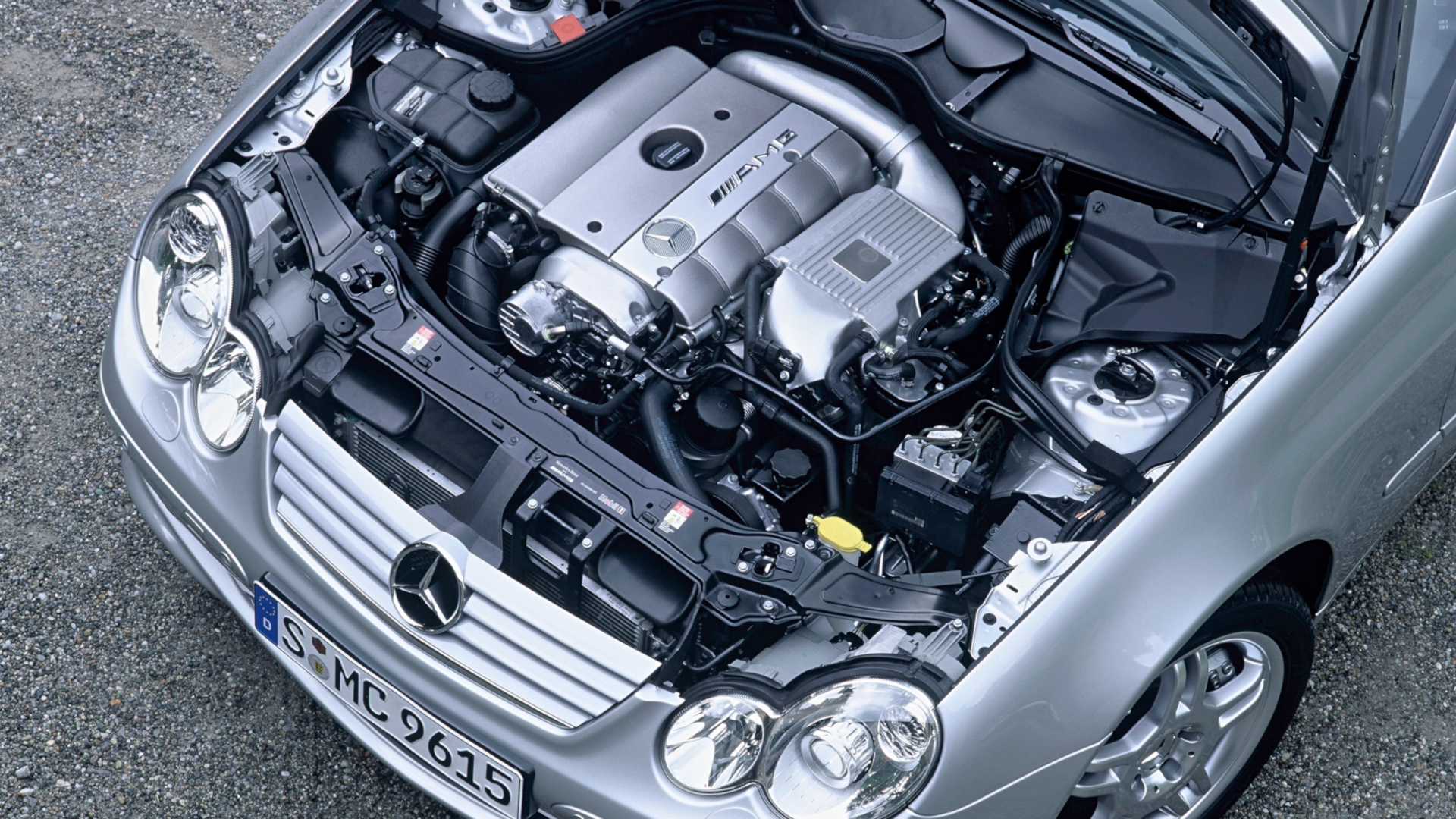
Mercedes-AMG Built A Diesel-Powered Sports Sedan, And It Bombed
AMG started as an outfit that prepped race cars, and it built one of the oddest models ever, which set the tone for the entire outfit going forward. The famous Red Pig was essentially a Mercedes-Benz S-Class (not a car you’d typically use for racing) with a massive 6.8-liter AMG-tuned V8 under the hood. And although the pairing was unlikely, it secured a class win at Le Mans.
Mercedes-Benz
- Founded
-
June 1926
- Founder
-
Karl Benz, Gottlieb Daimler, Wilhelm Maybach, and Emil Jellinek
- Headquarters
-
Stuttgart, Germany
- Owned By
-
Daimler AG
- Current CEO
-
Ola Källenius
The Red Pig also set the tone for AMG models for at least three decades. AMG-tuned models became known for being standard production cars with a body kit, beefed-up suspension and brakes, and, most important of all, a monster of an engine. Whether a V8 or a V12, Mercedes-AMG products were known for producing so much power that the traction control light was in a constant state of flicker. The 2003 E55 is perhaps the best example of early 2000s AMG madness. It competed directly with the 400-hp NA V8 E39 M5, so naturally AMG had to bless the car with a supercharged V8 producing 470 horses.
Why Move Away From V8 Madness?
There’s a clear correlation between the C30 CDI AMG and the current Mercedes-AMG C63 S E-Performance. In the early 2000s, politicians in Europe were advocating hard for passenger cars with diesel engines, because the fuel was thought to be more environmentally friendly. If you look back in the history books, you’ll see that most sedans of the time were available with a diesel engine, including the BMW 3 Series, Mercedes C-Class, and Audi A4. Even Alfa Romeo put a clattery diesel engine underneath the hood of the sublime 156, which is something this writer will never forgive them for.

Related
AMG Boss: V8 Could Live On Since US Has No End Date For Engine
The V8 could make a comeback, even in sedans where electrification has become the core focus.
Because oil-burners were extremely frugal, they quickly became the go-to for general consumers and fleet buyers. Diesel started outselling gas, and AMG had to react, just as Mercedes is now reacting to plug-in hybrids becoming more popular.
Mercedes Already Had A Diesel To Work With
The German brand actually has a long history with diesel. The OM617, which is one of the most reliable engines ever made, was in production from 1974 to 1991. Mercedes built naturally aspirated and turbocharged versions, and both were as reliable as a cheese grater. To this day, you’ll find Mercedes 300ds running around with a million miles on the clock.
The point is, Mercedes knows how to build a quality diesel engine, and when it came back into fashion in the late ’90s and early 2000s, it already had a modern 2.7-liter five-cylinder diesel available, mostly used by the Sprinter van. Mercedes quickly tuned this engine so it could be bolted under the hood of volume cars like the C-Class, E-Class, and ML.
How The C30 CDI AMG Was Made

|
Model |
Mercedes-Benz C30 CDI AMG |
Mercedes-Benz C55 AMG |
|---|---|---|
|
Engine |
3.0-liter turbocharged five-cylinder diesel |
5.5-liter NA V8 |
|
Power |
228 hp @3,800 rpm |
362 hp @ 5,750 rpm |
|
Torque |
398 lb-ft @ 2,000 rpm |
376 lb-ft @ 4,000 rpm |
|
0-62 mph |
6.8 seconds |
5.2 seconds |
|
Top speed |
155 mph |
155 mph |
First, the C30 was available in three body styles: sports coupe, sedan, and wagon. All versions used the same engine, which was a tweaked version of the 2.7-liter five-cylinder mentioned above. AMG increased the stroke, bolted a larger turbocharger to the engine, and upped the cooling. The results can be seen in the spec box above, next to the successor of the C32 AMG, which had already been announced.

Related
Each Generation Mercedes C-Class AMG Ranked By Acceleration And Quarter-Mile Times
There has been an AMG version of the C-Class Sedan since 1995. Here they all are, ranking by sprinting ability.
From the spec box above, we can see both good and bad. While the diesel and gas cars had the same top speed, the C55 got there much quicker, and it was more vocal while doing so. The C30 had more torque available from low down, however. But you just can’t argue with the C55’s power output, which was within spitting distance of the E39 M5. That’s not the only reason the C30 failed, however.
Why The C30 Really Failed
There’s a good reason nobody has ever built a diesel sports car, apart from Mercedes-Benz, which put a diesel engine in an SLK. Diesel engines suck at being sporty. They are very good at towing thanks to loads of low-end torque, and they are efficient. These aren’t attributes you want in a sports car. Firstly, you want to work an engine hard, and push it to the redline. In the C30, that redline was 4,000 rpm. That’s about half of what’s acceptable. Secondly, there was no pantomime.
The C55 and the C32 before it provided that in spades. You want a bit of drama and noise. Thirdly, diesel engines are large lumps, and if you bolt one under the hood of a sporty sedan, it’s going to understeer. Finally, the C30 was more expensive than its gas-powered brothers. Accounting for inflation, it cost the equivalent of $95,000, which was a lot more than the C55 pictured above. It’s no small wonder the C30 CDI only lasted for one model year and only sold around 800 units. Would you be able to walk right past the C55 and buy the more expensive, slower, and less aurally pleasing C30?
It Got Another Chance, But Not As An AMG
AMG soon realized that the attributes of a diesel engine didn’t quite fit in with what its customers wanted. The C30 was canned, but there was still room for a top-spec diesel that could slot in above the C200 and C220 diesel models. BMW was already working on inline-six diesel engines, so Mercedes had to react. The result was an all-new V6 turbocharged diesel, available as a 280 CDI or a 320 CDI. It was launched simultaneously in the ML and E-Class, with the C following a few months later.
The only difference between the two was the power output, and the C320 CDI introduced in 2005 received the 225 hp/376 lb-ft version. It was down on power and torque, but it no longer had AMG badges to live up to. It was simply another cushy C-Class, but fueled by diesel. People loved the low-end torque, now arriving at 1,600 rpm, and the fuel consumption, rated at 31 MPG combined. Just goes to show what a difference a badge can make.

Related
Next AMG C63 Won’t Get A Four-Cylinder, But It Might Not Get The Engine We Want Either
Conflicting rumors agree on more power for C-Class AMG.
The C30 CDI has no impressive legacy. It exists only as a reminder that certain things are not compatible with AMG, which is why Mercedes-AMG might want to rethink this whole four-cylinder C-Class thing. Rumor has it that it’s not going to put the V8 back in, instead opting for an electrified inline-six, but that hasn’t stopped at least one owner from ditching the four in favor of the old-school V8.
Sources: Mercedes-Benz