
Student-Designed Hyundai Obsidian Bring Cybertruck Vibes To A Sports Car
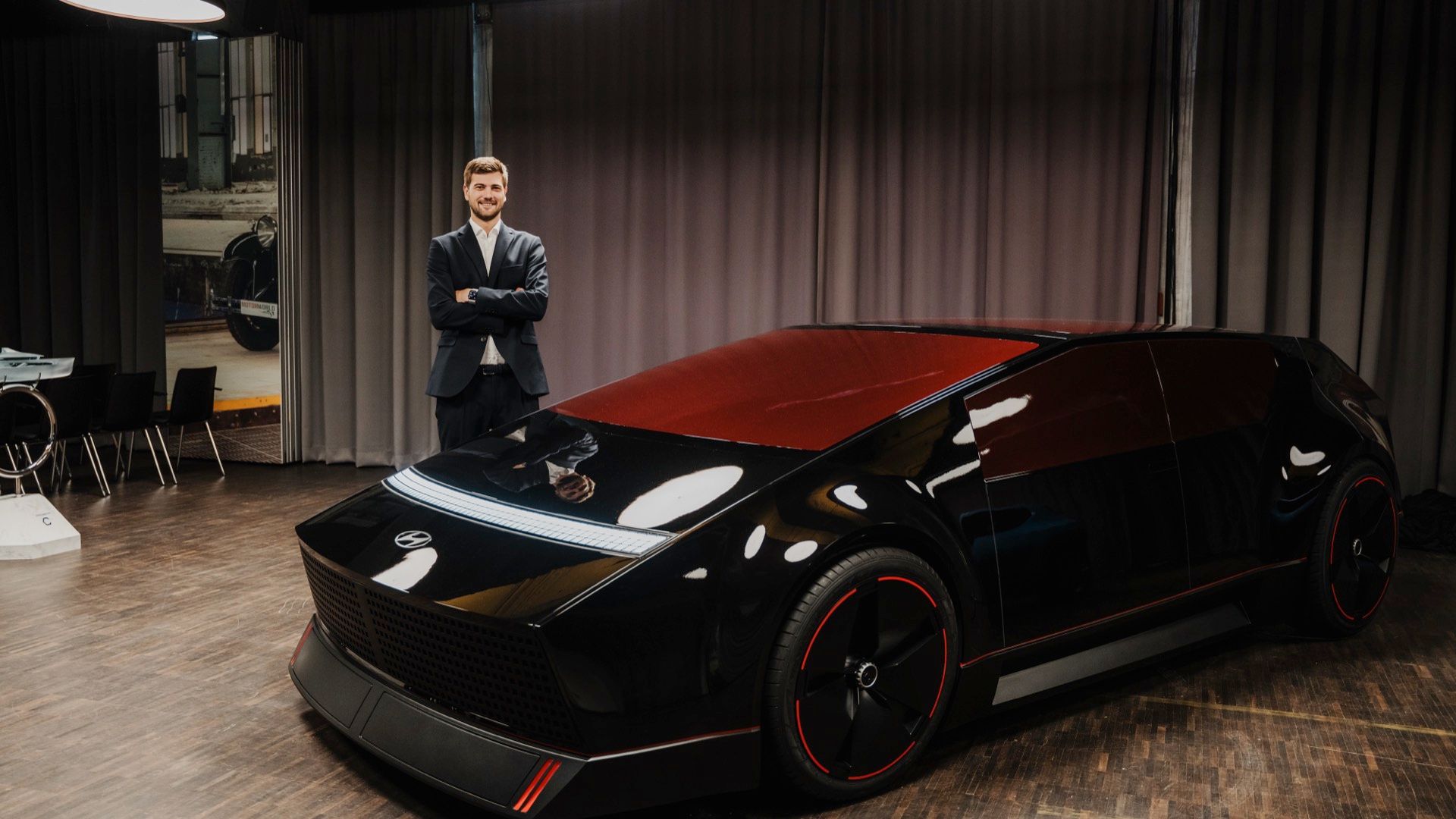
Hyundai has teamed up with the Munich University of Applied Sciences in Germany to come up with a concept for the Car Design Event 2025. The Hyundai Obsidian was not announced before the CDE 2025 event started, but overshadows the Hyundai Initium concept, the KIA EV2 Concept, and the Genesis X Gran Convertible concept. According to Korean Car Blog, the full-scale model, including the luxurious interior, comes from Transportation Design student Dominik Anders with “crucial” support from automotive Hyundai, the Munich-based design studio Apostrophe Design, and the AI-tool specialist Vizcom.
Hyundai
- Founded
-
29 December 1967
- Founder
-
Chung Ju-yung
- Headquarters
-
Seoul, South Korea
- Owned By
-
Hyundai Motor Group
- Current CEO
-
Jose Munoz
The Elephant In The Room
The project evolved from a brief by Eduardo Ramirez, head of design at Hyundai Europe, in the form of a simple question: “What could be the next enriching experience for Hyundai drivers?” Anders envisioned a sports car with a luxurious, spacious cabin and a monolithic silhouette.
Unfortunately, while it may be a technically brilliant piece of design, it also looks like the front half is heavily inspired by the Tesla Cybertruck, particularly the heavily angled windshield carrying on the line from the hood, and the back by 1970s shooting brakes. The Tesla Cybertruck itself is clearly inspired by 1970s ideas of what future cars would look like – particularly something called the UrbaCar, a concept that was featured in a 1975 edition of Mechanix Illustrated magazine.

Related
Hyundai’s Strangest Model Is Leading The Company’s Latest Design Direction
The brand looks to remain on the cutting edge of automotive styling.
More subtly, perhaps, the Hyundai Obsidian concept reminds us of another retro-futuristic concept, but from Honda. The Obsidian’s flat front facia with pixel LED headlights reminds us strongly of the Honda 0 Saloon, which in turn calls back to the Aston Martin Bulldog, which is clearly a heavy influence on, let’s say it together: The Tesla Cybertruck.
Let’s Remember, The Hyundai Obsidian Has Huge Value
There’s no mention of what could power the Hyundai Obsidian, and it’s going to be irrelevant as it is incredibly unlikely to get near production. However, we would love to see the accented wheels appear on a production car in the future. As a design touch, it is retro-futuristic, but it also helps fix the problem of black wheels on a black car having no definition. And that’s the point of concepts like this. They don’t exist as planned production cars, but as an idea as a whole, and to conceptualize specific ideas – like the accented wheels.

Related
VW Makes It Cheaper To Give The ID. Buzz Its Best Look
Volkswagen tells dealers to make its entry-level Buzz vans look like much costlier alternatives.
We should also remember that this is Hyundai working to help foster emerging talent and explore innovation in automotive design. Hyundai clearly sees talent in Anders and the people he worked with, and put his design center stage, surrounded by the other Hyundai concepts. This is a big moment for the young designer, and puts them on the world stage.

Related
Leave It To A Mercedes Designer To Create An Incredible Corvette
Some of the best Corvette features combine into a classic-style masterpiece.
Are We Now Locked In A Retro-Futuristic Infinity Loop?
We’re in an interesting period of automotive design that’s rough starting point came with the success of the Dodge Challenger when it emerged from the early 2000s attempts at retro-contemporary design but actually did it brilliantly. It leaned heavily into nostalgia, and every automaker has been doing that since. The retro-futuristic wave is the logical follow-on from that, and Hyundai has been one of the automakers blatantly playing with it in the form of concepts like the Retro N Vision 74 and more subtly, even brilliantly, with the Ioniq 5’s hot-hatch looks harking back to the 1980s.

Related
Skoda Vision GT Reimagines Classic Racers As A Futuristic Supercar
This is one way to change your brand image.
However, the danger is that in another 30 years, designers will be looking back to the 2020s for inspiration or as a way of triggering nostalgia in people who grew up seeing these cars when they were young. It’s a cynical thing to think about, but it does tickle us to imagine that in 2055, future journalists will be covering retro-futuristic concepts and cars inspired by retro-futuristic cars.
Source: Hyundai via Korean Car Blog