
The Brand With The Most Hybrids On Sale In America
There’s no denying Toyota’s long-running success in developing, marketing, and selling hybrid cars, trucks, crossovers, and even luxury models through its Lexus brand. Since the original Prius launched more than 25 years ago, Toyota’s hybrid lineup has expanded to the largest in the industry today. With 18 hybrid models on sale, no other automaker offers shoppers this much selection on hybrid power.
Toyota
Toyota is a Japanese automaker founded in 1937 that has developed a reputation for reliability across a multitude of segments, from sports cars and family sedans to pickup trucks and off-roaders. Famous models from the brand include the Hilux, Land Cruiser, Camry, Crown, and Corolla, the latter being the world’s best-selling vehicle nameplate, with more than 50 million Corolla-badged vehicles being sold since it was first introduced. Toyota typically competes in the mainstream market, but is also famous for launching Lexus as a luxury sub-brand to take on Mercedes-Benz.
- Founded
-
August 28, 1937
- Founder
-
Kiichiro Toyoda
- Headquarters
-
Aichi, Japan
- Owned By
-
Publicly Traded
- Current CEO
-
Koji Sato
Below, we’ll dive into how both types of Toyota Hybrid engines work, where you’ll find them, and what you’ll pay for each. We’re also covering some of the top terminologies you’re likely to encounter when shopping for a Toyota Hybrid in 2025, and what they mean.
For this feature, we’re focusing on new and recent Toyota hybrid models, including both standard and Plug-In Hybrid versions. All MSRP and technical data is sourced from the manufacturer.
How Toyota Hybrids Work
When you combine two things into one, you get a hybrid. Do you have a Labradoodle? That’s a Labrador Retriever / Poodle hybrid. Have you ever used a spork? That’s a spoon-fork hybrid. Broccolini with your supper? Also a hybrid, in this case broccoli mixed with Chinese Kale.
Hybrid engine in your Prius? That’s a gasoline-electric hybrid, as defined by its engine. A hybrid engine works just like a regular engine: you put gas in its fuel tank and drive around, and fill it up again when it’s empty. The hybrid engine runs on gas but works in sync with one or more electric motors and a dedicated battery. This blending of gas and electric power is what makes it a gas-electric hybrid.
|
2025 Toyota RAV4 Hybrid Specifications |
|
|---|---|
|
Engine |
2.5-liter four-cylinder gas hybrid NA |
|
Horsepower |
219 hp |
|
Torque |
176 lb-ft |
|
Drive |
AWD |
A lot of things are spinning rapidly when you drive your car, including the wheels and (usually) the engine. A gas-electric hybrid uses special hardware to generate electricity from these spinning parts, automatically charging the battery as you drive around. The power generated is stored in the battery, and can be sent to the electric motor(s) to do some of the work of driving the car, decreasing the demand on the gas engine and saving fuel while improving performance. When conditions are right, the gas engine can even be turned off, allowing the vehicle to drive for short periods only using battery power.

Related
Why Diesel Hybrids Aren’t More Readily Available
Diesel engines are legendary for their fuel efficiency. So if they’re used in a hybrid setup they’d be even more awesome, right? Not quite. Here’s why
Why Some Toyota Hybrids Have Plugs While Others Don’t
Hybrids come in at least two types: hybrids that don’t have plugs, and hybrids that do. Both work the same way, but there’s one key difference.
In both the standard hybrid and plug-in hybrid, there’s a gas engine and self-recharging battery. Since this battery is entirely self-recharging, there’s no need for a plug because all power required is generated on board. A standard hybrid like the Corolla Hybrid can drive in fully-electric mode, but usually only for a moment or two at a time because the storage capacity of its battery is relatively low.
|
2025 Toyota Prius Plug-In Hybrid Specifications |
|
|---|---|
|
Engine |
2.5-liter four-cylinder gas hybrid NA |
|
Horsepower |
220 hp |
|
Torque |
139 lb-ft |
|
Drive |
FWD |
In a Plug-In Hybrid (PHEV), the hardware arrangement is virtually identical but the self-recharging battery has a much higher storage capacity. In fact, the PHEV battery can store so much electricity that the hybrid engine’s integrated generator capabilities can only charge it to a fraction of its capacity in a timely fashion as you drive around. To fill the battery in a PHEV like the Toyota Prius Plug In Hybrid completely, you’ve got to plug in – likely in your driveway or garage overnight while you’re asleep.
When the large battery in the PHEV is full, it stores enough electricity to drive dozens of miles before any gasoline is required. Once the charge is used up, the vehicle automatically switches to gas-hybrid mode and you keep on driving. The hybrid engine can sustain the battery for hybrid operation as long as there’s fuel in the tank. Plugging in is never required, but every time you top up the PHEV battery by connecting it to a charger, you’re storing enough electricity for a few dozen more miles of gas-free driving.
What You’ll Pay For A Toyota Hybrid In 2025
The cheapest Toyota Hybrid in 2025 is the Corolla Hybrid, with a starting MSRP of $23,825. The priciest is the Sequoia SUV at $62,425. Across the nearly $40,000 gap between them is the remainder of a list of 16 standard hybrids and two plug-ins, for a total of 18 models to choose from.
|
Toyota Hybrid Models |
|
|---|---|
|
2025 Toyota Corolla Hybrid |
$23,825 |
|
2025 Toyota Camry |
$28,700 |
|
2025 Toyota Prius |
$28,350 |
|
2025 Toyota Corolla Cross Hybrid |
$28,495 |
|
2025 Toyota RAV4 Hybrid |
$32,300 |
|
2025 Toyota Sienna |
$39,185 |
|
2025 Toyota Crown |
$41,440 |
|
2026 Toyota Crown |
$41,440 |
|
2025 Toyota Crown Signia |
$43,790 |
|
2025 Toyota Grand Highlander Hybrid |
$44,210 |
|
2025 Toyota Highlander Hybrid |
$46,320 |
|
2025 Toyota Tacoma i-FORCE MAX |
$46,320 |
|
2025 Toyota 4Runner i-FORCE MAX |
$51,990 |
|
2025 Toyota Land Cruiser |
$56,700 |
|
2025 Toyota Tundra i-FORCE MAX |
$58,005 |
|
2025 Toyota Sequoia |
$62,425 |
|
Plug-in Hybrid Models |
|
|
2025 Toyota Prius Plug-in Hybrid |
$33,375 |
|
2025 Toyota RAV4 Plug-in Hybrid |
$44,265 |

Related
10 Toyota Hybrids You Can Buy For Less Than $50,000
There’s a Toyota hybrid for any budget, as Toyota forgoes EVs in favor of a mass hybrid assault.
Here’s a list of important terminologies you’re likely to encounter when buying a Toyota hybrid in 2025, and what they mean:
|
Net Combined Horsepower |
The horsepower ratings of hybrid cars can be a little tricky, as their gas engine and electric motor(s) each have a specific horsepower number, though these don’t add together directly. When shopping for a Toyota hybrid, be sure to look for the ‘Net Combined Horsepower’ figure to make sure you’re comparing apples to apples (against the competition). Take the 2025 Toyota Prius Plug In Hybrid for instance: its gas engine makes 150 horsepower, and its electric motor makes 161 hp. With the two combined, total hybrid system net power is 220 horsepower. |
|
Toyota Safety Sense (TSS) |
The TSS system was introduced several generations ago and has evolved continually ever since. Today, you’ll find this networked array of driver assists standard on all Toyota models, with most models offering the latest version 3.0 of the TSS system. |
|
E-AWD |
Some Toyota hybrids like the Prius and RAV4 use the brand’s E-AWD system, which features a rear axle with a dedicated electric motor for driving the rear wheels. When required, the E-AWD rear motor can power the rear wheels when traction is low, automatically switching off to save energy when grip is regained. The E-AWD system is fully electric and doesn’t require a driveshaft, differential or other heavy AWD-related hardware to do its job. A key benefit? Since this AWD system is designed to be as efficient as the hybrid engine powering it, most Toyota E-AWD models come with virtually no fuel cost penalty versus their two-wheel-drive counterparts. |
|
EV Mode |
The Toyota hybrid you’re considering has an ‘EV mode’ that can be engaged at the press of a button. While the brand’s Plug-In Hybrid models are capable of dozens of kilometers of all-electric driving, the EV mode on Toyota’s standard hybrid models allows drivers to run solely on stored power for short distances at low speeds, perhaps while in a parking garage, drive-thru or residential area. When the hybrid battery runs low, the gas engine automatically turns on to recharge it. |
|
Prime |
Originally, the ‘Prime’ nameplate was used on Toyota Plug-In Hybrid (PHEV) models. For instance, the Prius and RAV4 were both offered with standard hybrid and plug-in hybrid engines, with the plug-in versions wearing Toyota’s ‘Prime’ badge. Note that for the 2025 model year, the automaker has dropped the Prime designation, and Toyota PHEV models are now referred to simply as Plug-In Hybrids. |
|
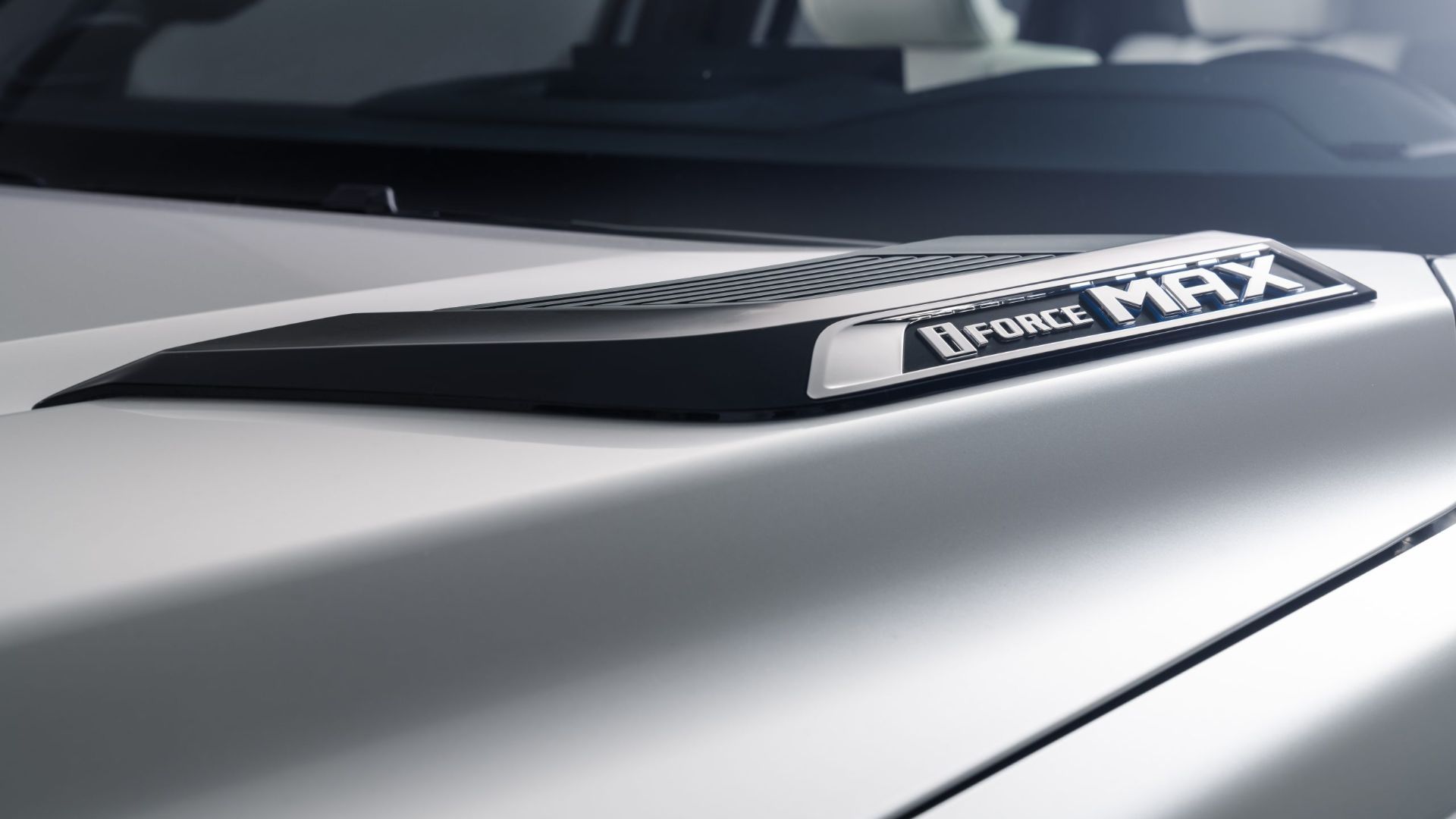
i-Force Max |
Toyota’s i-Force engine range has powered generations of pickups, the most recent of which are offering both i-Force and I-Force Max options to Toyota Tundra and Toyota Tacoma shoppers. The i-Force engine range features turbocharged four and six-cylinder powerplants, and the i-Force Max versions of these engines pack added power and torque with hybrid hardware. Both the Tacoma and Tundra offer i-Force Max engines for your consideration. |
Sources: Toyota