

The First-Gen Hyundai Veloster Turbo Is Worth A Second Look At $20,000
Twenty or thirty years ago, Hyundai was a rather understated brand and, in many respects, was neither here nor there in the US market. However, slowly but surely it gained considerable credibility and was able to deliver products that resonated with American consumers and rivaled performance-oriented competitors at the same time.

- Base Trim Engine
-
1.6L Inline-4 Gas
- Base Trim Transmission
-
6-Speed Manual
- Base Trim Drivetrain
-
Front-Wheel Drive
Part of this growing success was due to models such as the Veloster Turbo, which may not have had many track credentials out of the box but nonetheless offered a fresh take on compact car performance. Today, this car has aged far better than anyone might have expected, and it’s good to know that you can find some clean and low-mileage examples of these sporty vehicles for not much money at all.
We took a closer look at the first-generation Hyundai Veloster Turbo, which came out in 2013 and featured a quirky design. We assessed what it might be like to own today and why it appears to be a solid bargain. Information in the article comes from the manufacturer’s website and authority sources and any opinions in the article are those of the author.
What You Might Get for Your 20K
|
2013 Hyundai Veloster Turbo Specifications |
|
|---|---|
|
Engine |
1.6-liter turbocharged inline-four |
|
Transmission |
Six-speed manual or automatic |
|
Drivetrain |
Front-wheel drive |
|
Power |
201 hp |
|
Torque |
195 lb.-ft |
Today, you can find a well-kept first-generation Veloster Turbo for around $20,000 in the used car market and often, with less than 50,000 miles on the clock. In fact, there’s a multitude for sale right now for under our $20,000 budget, and Kelley Blue Book’s fair purchase value suggests bargains can be had for even less, too. That’s definitely affordable and good value, and especially if you consider that a similar-condition Golf GTI or Civic SI may command thousands of dollars more. Furthermore, most people treated these Velosters as daily drivers rather than track toys, so previous owners will probably not have thrashed those lower mileage examples.
Look for the 2016 and 2017 models if you can, as these later first-generation vehicles have certain refinements like better throttle response, upgraded interior tech, and suspension tuning. You could even find a Rally edition or a much-loved Turbo R-Spec if you want sharper dynamics. Certainly, the R-Spec will be a little short on creature comforts to cut down on its weight, but it does have stiffer dampers, B&M short-throw shifters, and revised steering feel, so it’s definitely the enthusiast’s pick.
On board the base Veloster Turbo you’ll find a lot more than you might expect in a modern compact. For example, you’d get a seven-inch touchscreen, back-up camera, and Bluetooth audio, as well as a panoramic sunroof and navigation system in later models. The quality of the build was good and holds up well today, plus many owners took advantage of Hyundai’s excellent extended warranty, so the vehicle that you find now may have good paperwork and dealership maintenance credentials.

Related
Hyundai’s Forgotten 3-Door Hot Hatch Is Still An Enthusiast’s Dream Today
The Hyundai Veloster N was a great and often-overlooked hot hatch. Why was it so good back then and still relevant today?
The Veloster Turbo’s Bold First Impression
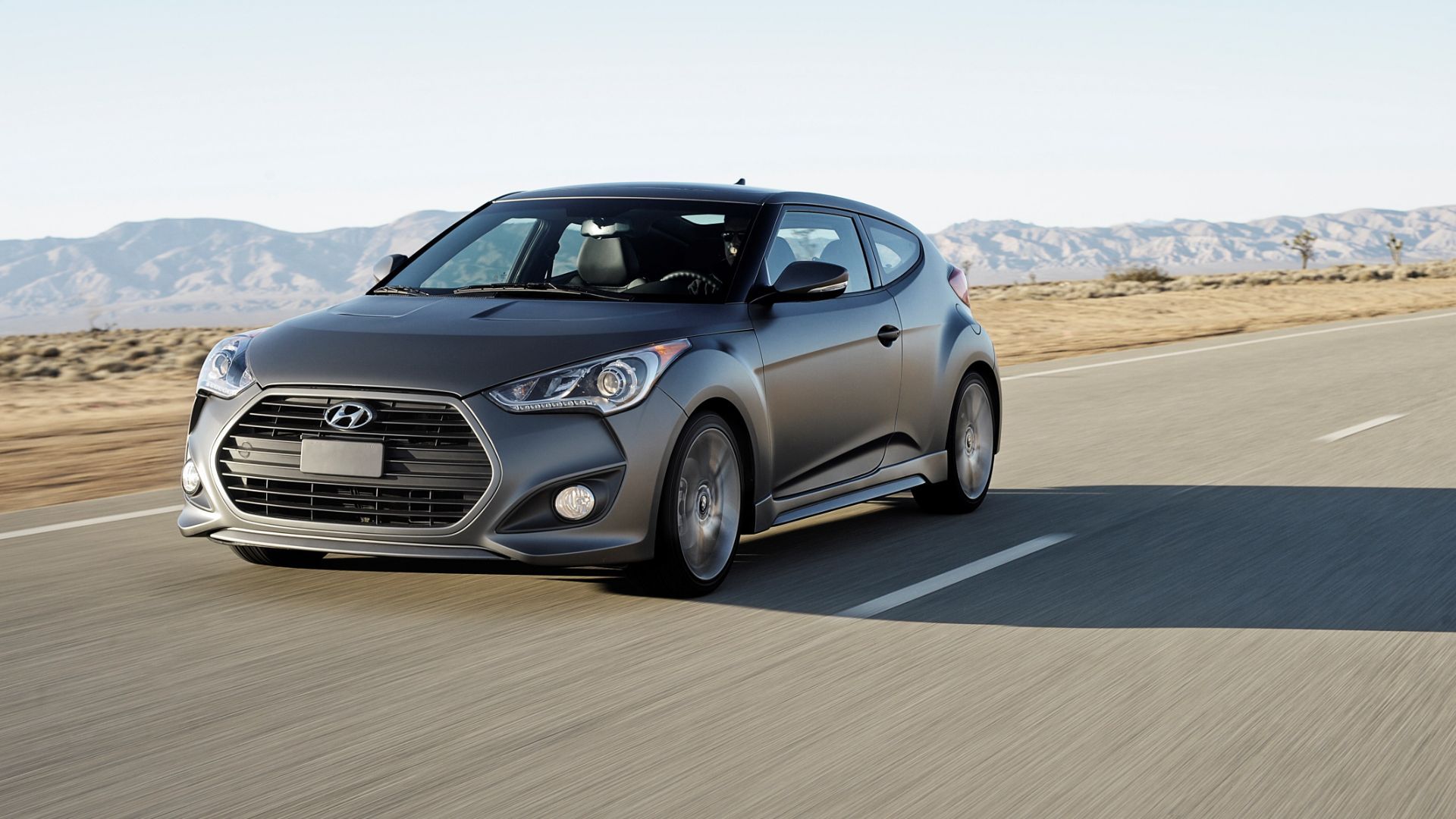
When Hyundai launched the original Veloster in 2011, it was the company’s most daring design to date. This was a compact with a three-door configuration, featuring two doors on the passenger side and one on the other. This was certainly a stylistic gamble and turned heads, but it wasn’t an outright winner in the sales department. Yet when the Veloster Turbo said hello during the 2013 model year, things changed and the car was now a credible and serious hot hatch contender.
Under the hood of the Veloster Turbo, you’ll find a 1.6-liter turbocharged inline-four which delivers a handy 201 hp and 195 lb.-ft of torque, through either a six-speed manual or automatic transmission. And remember, the car was relatively light at just under 3,000 lbs, so it could sprint off the line and get to 60 mph in 6.7 seconds. This puts it firmly in that hot hatch territory alongside some other rivals such as the Mini Cooper S or Ford Fiesta ST.
The Veloster Turbo certainly looks the part with its aggressive front grille and rear diffuser, centrally placed dual exhausts and flared rocker panels. From the outside, this surely wasn’t an economy car, but something far sportier altogether, and the company even added unique wheels, LED accents, and body-color trim to place it apart from the base model. Inside, you’d get sports seats with contrast stitching, plus a leather-wrapped steering wheel to give you more of a premium feel than you might expect at its price point.

Related
Best Turbocharged Hatchbacks Of 2025
These hatchbacks deliver strong performance and decent practicality.
How the Veloster Turbo Performed on the Road
The Veloster Turbo was quite assured on the road. Certainly, it didn’t claim to be a track star, but it was certainly fun for some spirited backroad driving. It had a predictable front strut and rear torsion beam setup, but it also had a short wheelbase and low weight, so it cornered well and felt nimble in urban environments. Yes, you’d get some torque-steer, but it wasn’t anything crazy, and the electric power steering was direct and predictable. The six-speed manual transmission was precise, and the gears were spaced well for quicker shifts throughout the power band. Unlike some sports compacts that seem to sacrifice daily usability for performance, you’d get a good balance in the Veloster Turbo. And with fuel economy figures that hovered around 30 MPG combined, it was – and remains – quite economical. If you really wanted to push the envelope, then you could choose the Rally edition or R-Spec, which had exhaust tuning and suspension tweaks to give you a more responsive and fun ride.

Related
10 Cheap Fast Cars To Buy In 2025
Performance doesn’t always have to come at the expense of value.
Here’s What Veloster Turbo Ownership Could Look Like
The Veloster Turbo is an excellent choice if you have modding in mind. After all, it has the 1.6T Gamma engine, which the aftermarket supports well and is similar to other applications across the Hyundai-Kia range. You can add cat back exhausts and cold air intakes or tune the ECU, and even add an upgraded intercooler to try and push your output closer to 250 hp. Even basic bolt-ons can dramatically improve mid-range torque and throttle response and if you add some suspension tweaks as well, you’re off to the races, quite literally. The Veloster Turbo also has a strong enthusiast base through forums, groups, and threads, so you can easily get advice and input on builds, repairs, or other issues. It certainly has a strong ecosystem to make your ownership more accessible and enjoyable.
Long-term maintenance costs are relatively low, especially if you compare them to some turbocharged European rivals. Some of the common issues could include valve cover gasket seepage, wastegate rattle, or uncooperative infotainment systems, but most of these are relatively small fixes and OEM parts are still quite inexpensive. So, all in all, a Veloster Turbo could give you a low-risk entry into performance car ownership, especially when you consider that insurance is quite reasonable and many states will charge you a lower registration fee due to the car’s compact spec.
The first-generation Hyundai Veloster Turbo may not have commanded a lot of respect when it was new, but today, especially for $20,000 or less, it’s definitely worth your consideration. After all, it could be a compelling used car for someone who wants a combination of decent speed, standout looks, and real daily practicality. And while it may not have the outright performance of a Focus ST or GTI, it still delivers a healthy dose of affordable fun. So, for anyone who wants to stand out in the crowd on a budget, it may well be worth looking at this weird, willing, and wallet-friendly hatch.
Sources: Hyundai.