
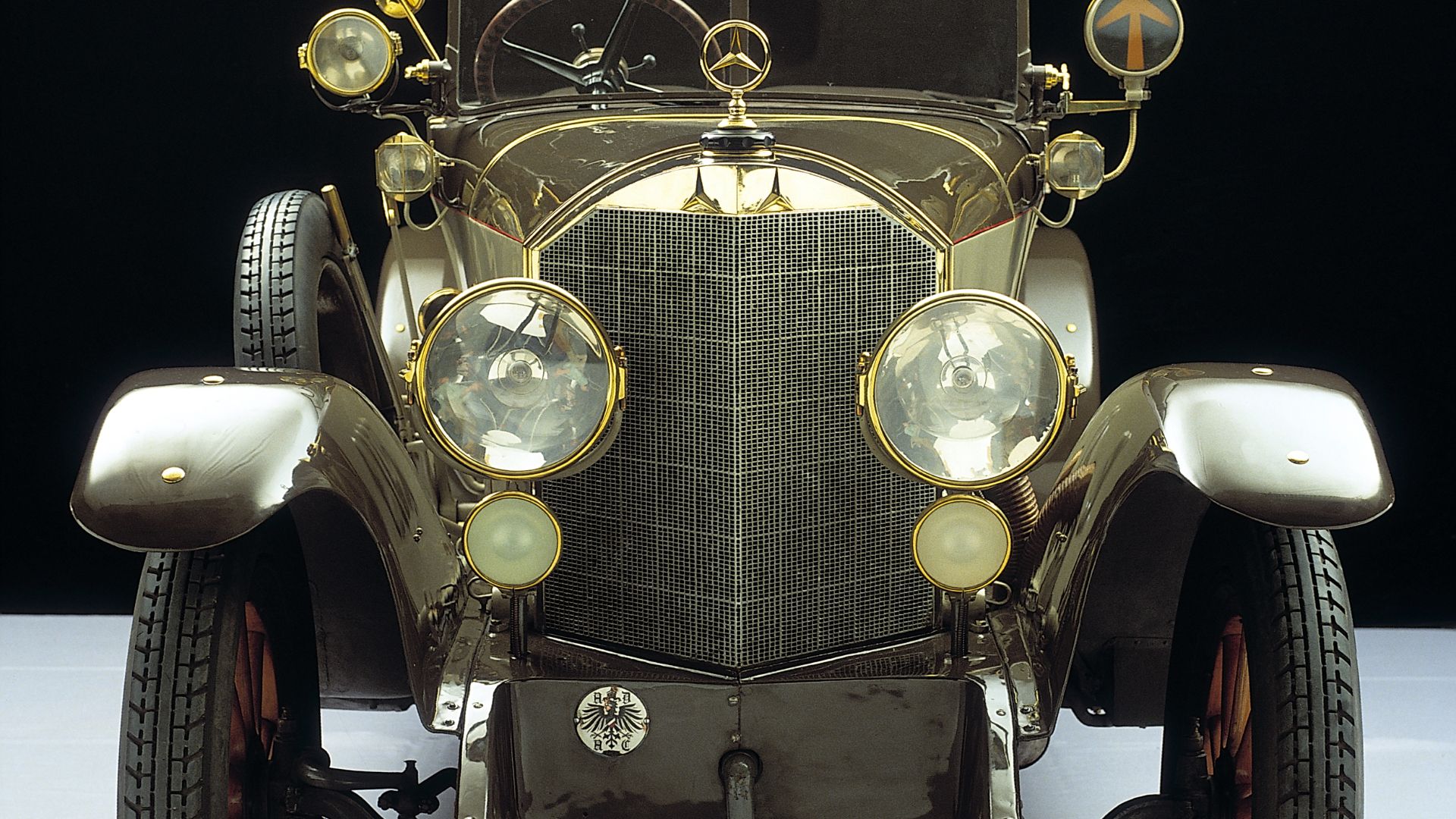
The Honeycomb Radiator Design Revolutionized Combustion Engine Cooling
It’s been 125 years since one of the auto industry’s most celebrated designers filed a patent for a device that would become a central characteristic of the modern car to this very day. Even today’s most advanced Mercedes-Benz, the One, wouldn’t be possible without the effective cooling of its combustion engine, which has been a prerequisite for producing a strong power output since the very beginning. Modern cars use various means of keeping their engines running cool – and most of those methods can be traced back to Wilhelm Maybach’s original patent for the honeycomb radiator design. It’s not clear if he knew it at the time, but Maybach had simultaneously given customers a tremendous win, kicked off a styling war, and unlocked the potential of gasoline engines for the next 125 years or more.
Wilhelm Maybach filed a Patent Application For The Honeycomb Radiator in 1900
The year is 1900. It’s well over a century before Mercedes built their ultimate performance car, the One, but a technical foundation and spiritual predecessor to this modern-day legend is springing into action. According to Mercedes-Benz, a powerful new four-cylinder engine in a new high-performance car called the 35 hp signaled things to come for future automobiles. In the day, the press reported that French design engineers had nothing to challenge it, as the 35 hp conquered various challenges at a spectator motorsports competition in France that earned the car plenty of headlines.
|
Mercedes-Benz AMG One |
|||
|---|---|---|---|
|
Engine |
1.6-liter V6 hybrid |
||
|
Power |
1063 hp |
||
|
Torque |
NA |
||
|
Transmission |
7-speed automatic |
||
|
Drive |
AWD |
||
|
0-60 |
2.9 sec |
||
Experts later called the 35 hp the first modern automobile, thanks in part to its systematic design for performance, weight savings, and safety. The big four-cylinder engine was made of “light metal” according to Mercedes-Benz, helping save weight. The use of a light metal engine required a powerful and lightweight cooling system that could pack maximum cooling capacity into the most compact possible design. The result of this idea is visible on the 35 hp’s nose, with the world’s first high-performance radiator unit.

Designed specifically as a high-performance alternative to earlier tube-style radiators, Maybach filed a patent for the new honeycomb radiator design, which he intended to deliver maximum cooling capacity with a compact design. Though the modern radiator doesn’t share the square tube design like Maybach’s original, the technical principle of the honeycomb radiator remains in place today.
The original patent application was filed as a “cooling and condensation device based on the cross-flow principle.” The patent was granted on August 8, 1901, by which point the new technology was already proving itself and being prepared for upcoming applications.
Early Tube-Style Radiators Weren’t Very Good, But A Solution Was On The Way

Earlier attempts to cool engines with water weren’t very good. Before early closed-loop systems like the first tube-style radiators, the engine’s cooling water wasn’t contained in a closed loop, and simply evaporated. Drivers had to refill their engines’ water supply on occasion, and if they didn’t, they had to deal with overheating. As engines got more powerful, a better solution was necessary.
Among the first of these solutions was the early tube-style radiator, which Maybach described as an “apparatus for cooling the water flowing around the cylinders of internal combustion engines, consisting of a flat vessel traversed by a large number of tubes, whereby a stream of air generated by a suitable ventilation device passes continuously through the tubes and extracts the heat from the cooling water”.

The tubes were made of brass because that alloy of copper and zinc has very good thermal conductivity. This then-new cooling system was first used in September 1898 in the world’s first road vehicle with a four-cylinder engine, the Phoenix horseless carriage, which had eight horsepower. Trouble was, engines were about to get a lot more powerful, and a higher-performing alternative was needed to replace the early tube-style radiator.
Here’s How The World’s First High-Performance Radiator Worked

Further developing on the tube-style radiator, Maybach had a new type of radiator soldered up, this one using 8,070 square tubes measuring about a quarter-inch per side. Unlike round tubes, square ones can be stacked against each other without any wasted space. As the 35 hp moved, the airstream was forced through a multitude of tubes, mounted side-by-side in a construction that looked similar to a honeycomb when viewed head-on. It’s anyone’s guess whether he knew it at the time, but Maybach’s first radiator would go on to form a hallmark styling element of the next hundred-plus years of Mercedes design.

The increased inner surface area of the square tubes and smaller gaps between individual tubes meant that more cooling power could be fitted into the same physical space, enabling much higher engine performance. Compared to the Phoenix from a few years earlier, the Mercedes 35 hp’s innovative cooling system allowed it to deliver 4 times the power of its predecessor while cutting water consumption in half. That’s the sort of win-win engineering Mercedes customers expect to this day. A fan kept air moving over the radiator when the vehicle stopped, just as they still do. This early high-performance radiator had solved the problem of cooling the combustion engine, once and for all.
The Honeycomb Radiator Was Worn Very Proudly By Its First Models, And Became A Styling Trend
When the Mercedes 35 hp launched, the honeycomb radiator stood out on the front of the vehicle, presenting itself to the airstream. Because of this, it had an immediate effect on brand image and became a sort of signature styling touch when it first hit the road. In 1911, a version of the honeycomb grille with a distinctive vertical fold at its front edge was introduced, enabling an even larger cooling surface. Because this style of honeycomb radiator was more complicated to produce, it was reserved for vehicles with the most powerful engines.

The design was copied by various other automakers at the time, with the media of the day reporting from the Paris Motor Show in 1902 that the previously unknown honeycomb radiator was popping up all over the place. Before long, a front end with an upright radiator became standard practice until well into the 1930s as competitors rushed to imitate.

It was in 1931 that the Mercedes-Benz 170 first mounted the radiator behind a grille for protection. Now fitted with a rectangular radiator cover styled to resemble the radiator itself, designers had a new opportunity to enhance the brand’s image, and drivers got added protection from dirt and damage. This was an early example of Mercedes influencing the entire auto industry.
Future Innovations Help Keep Things Cool With More Compact and Efficient Designs
A multitude of new components, hardware, and applications are available to automakers in 2025, all based on the same principles laid out in Maybach’s early patent. Today, automakers use radiators and heat exchangers to cool engines, transmissions, differentials, EV batteries, and even the boost charge created by supercharged or turbocharged engines.

The world’s fastest cars, like the Bugatti Chiron and Porsche 911 Turbo S, have multiple heat exchangers mounted strategically within their bodies, placed in carefully sculpted air pathways to turn otherwise-unused space into additional high-performance cooling power. Maybach’s early principle of delivering maximum cooling power from the most compact size possible is still alive and well today in 2025.
Sources: Mercedes-Benz