
The Most Iconic British Sports Cars of All Time
When car enthusiasts are asked about their favorite car of all time, British sports cars crop up frequently: legendary models like the Jaguar E-Type or the Aston Martin DB5 have cemented their place in the automotive industry’s hall of fame, becoming icons of design and cultural shorthand for their respective historical eras.
These cars’ legacy was also carried forward elsewhere in the world: the Mazda MX-5 Miata, one of the most popular and famous small sports cars of all time, takes direct inspiration from the golden age of British sports cars, embodying the principles of enjoyable and affordable motoring for all. In this list, we have selected ten British sports cars that have earned the status of icon over the decades.
This list includes ten of what we consider to be the most iconic British sports cars in history. Items are listed in chronological order, from the oldest to the newest. All specs refer to the first generation of each model.
1
Austin-Healey Sprite
Year Released: 1958
|
Engine |
948 cc inline-four |
|---|---|
|
Horsepower |
43 hp |
|
0-60 |
20.5 seconds |
|
Top Speed |
82.9 mph |
The first entry on our list may not be very well-known outside the UK and classic car enthusiast circles, but its unique style helped set the blueprint for several other classic British sports cars. The Austin-Healey Sprite was unveiled in Monaco two days after the 1958 Formula 1 Grand Prix; it was intended to provide affordable, fun motoring for the average driver.

Related
Jay Leno’s Austin-Healey Is The Ultimate Bare-Bones Motoring Experience
This entirely original Sprite is an icon in the British sportscar world.
The Sprite was the product of a collaboration between the Austin Motor Company and the Donald Healey Motor Company: while the former provided the car’s engine, the latter took care of the design aspect, creating the iconic look affectionately referred to as “frog-eye” in the UK and “bug-eye” in the US. Today, the Sprite remains a firm favorite among classic car enthusiasts of all ages, including, apparently, babies.
2
Jaguar E-Type/XKE
Year Released: 1961
|
Engine |
3.8L/4.2L NA I6 |
|---|---|
|
Horsepower |
261 hp |
|
0-60 |
6.4 seconds |
|
Top Speed |
~150 mph |
The Jaguar E-Type, known in the States as the XK-E, is one of the most iconic cars in history thanks to its instantly recognizable design. First launched at the 1961 Geneva Motor Show, the E-Type was based on the D-Type race car, which had claimed three consecutive Le Mans victories in the mid-1950s.

Related
Legendary Jaguar D-Type Brought Back From The Dead
25 Jaguar D-Types are going back into production, all in original Le Mans specification.
It was famously described by one Enzo Ferrari as “the most beautiful car in the world”, and over the decades it has earned itself a place in countless lists of “most beautiful cars of all time”, ours included. Looking at it, it’s easy to see why: its sweeping, curved lines give it a timeless silhouette that’s always elegant and never dated.
3
Triumph Spitfire
Year Released: 1962
|
Engine |
1.1L NA I4 |
|---|---|
|
Horsepower |
62 hp |
|
0-60 |
16.4 seconds |
|
Top Speed |
92 mph |
Named after the famous World War II fighter plane, the Triumph Spitfire was the brainchild of Italian designer Giovanni Michelotti. First introduced at the 1962 London Motor Show, it remained on the market for 18 years, with five different generations along the way; today, it still remains a favorite in classic car enthusiasts circles.

Related
The 10 Cheapest Cars That Will Give You That Weekend Roadster Experience
Looking for cheap thrills? Check out these 10 super-cheap drop-tops you can get on the used market.
It was designed to be a direct competitor of the Austin-Healey Sprite; however, it came very close to not being built at all. Triumph ran into severe financial issues around the time the Spitfire was supposed to be introduced; when a takeover deal was eventually struck with Leyland Motors, Michelotti’s design sketches were found by accident in a factory, and the Spitfire was finally sent to production.
4
Aston Martin DB5
Year Released: 1963
|
Engine |
4.0L NA I6 |
|---|---|
|
Horsepower |
278 hp |
|
0-60 |
8 seconds |
|
Top Speed |
145 mph |
The Aston Martin DB5 is one of the most widely-known Aston models in the world, largely thanks to its cinematic fame as it was heavily featured in several James Bond movies. Its sleek, elegant style and sweeping roofline made it the perfect Bond car: although the original novels mentioned a DB Mark III, special effects artist John Stears convinced Aston Martin to use its DB5 prototype for filming.

Related
Aston Martin Gathers 5 DB5 Goldfingers For One Time Only
You’ll never see a gathering of Goldfingers this large again.
Its first on-screen appearance was in 1964’s Goldfinger; the DB5 then came back for the franchise’s next movie, Thunderball, the following year. Decades later, subsequent instalments would pay homage to the DB5: in the mid-1990s, GoldenEye and Tomorrow Never Dies both featured DB5s. Its last appearance was in 2006’s Casino Royale, this time driven by a villain rather than by Bond himself.
5
MG MGB
Year Released: 1962
|
Engine |
1.8L NA I4 |
|---|---|
|
Horsepower |
93 hp |
|
0-60 |
~11 seconds |
|
Top Speed |
~100 mph |
The 1960s were a golden age for British sports cars, with countless stylish, lightweight and affordable models being released on the market. The MGB was one such car, bringing technological innovation as well as appealing design: rather than using a traditional body-on-frame construction, which was most common at the time, it was built around a monocoque chassis.

Related
MGB Reborn With V8 And Electric Powertrain Options
The EV revs to 9,000 rpm and uses a manual gearbox.
Not all the car’s components, however, were brand new: the MGB blended modern elements with older ones, borrowing its brakes and suspension from its predecessor (the MGA) and using an engine whose design first originated in the late ’40s (the BMC B-Series). While the Roadster version was the first to arrive on the market, the hard-top GT version was released shortly afterward, becoming one of the most popular variants of the model.
6
Morgan Plus 8
Year Released: 1968
|
Engine |
3.5L NA V8 |
|---|---|
|
Horsepower |
161 hp |
|
0-60 |
6.7 seconds |
|
Top Speed |
124 mph |
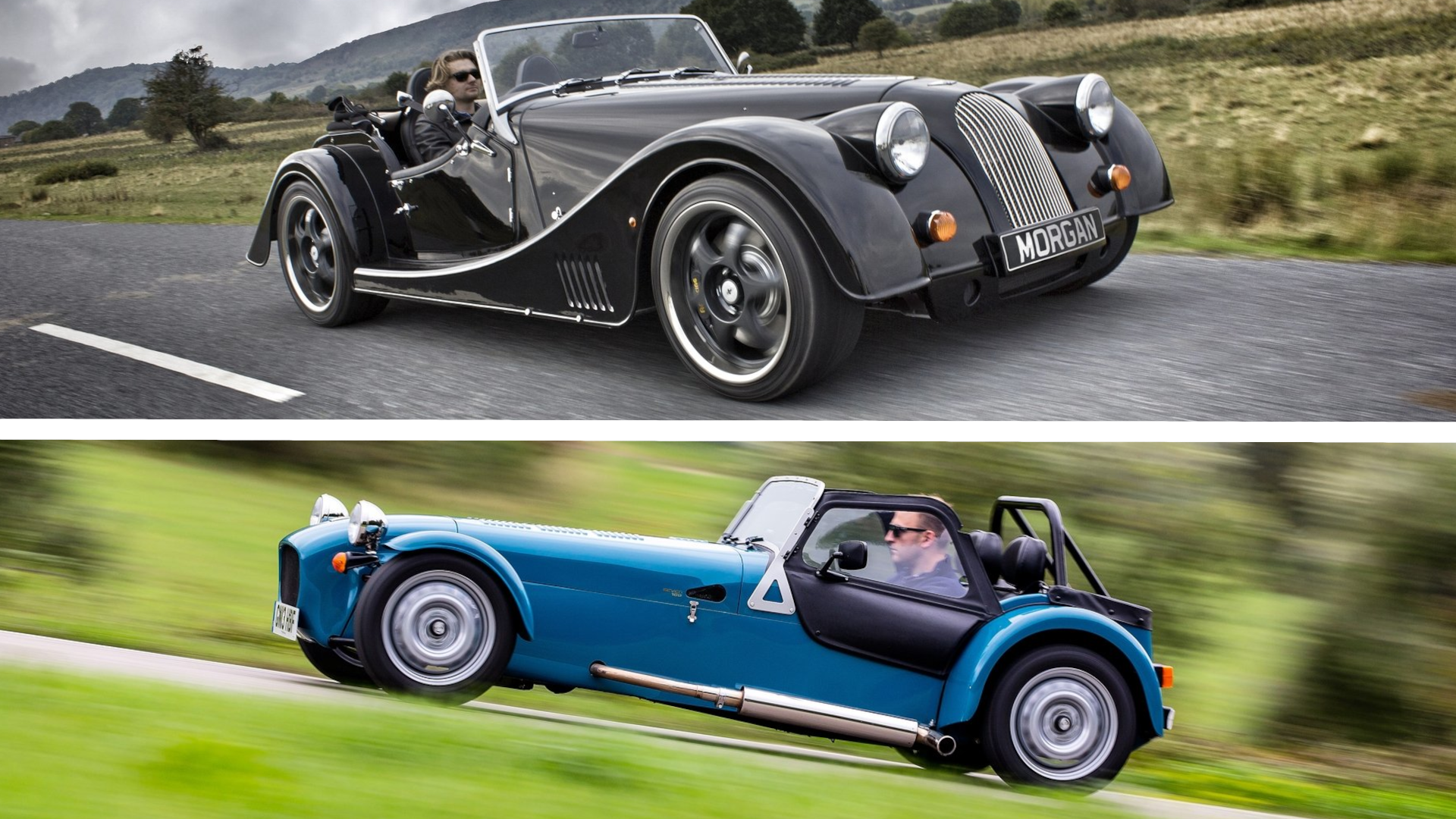
The Morgan Motor Company has a fascinating history and design philosophy, building cars that carry over distinctly retro styling cues and adapting them for the modern era. The Morgan Plus 8, one of Morgan’s most popular models, has had an incredibly long lifespan: barring an 8-year break between 2004 and 2012, it remained in production for half a century, albeit with different powertrain options and slight design changes.

Related
Morgan’s BMW-Powered Roadster Touches Down With More Colors Than Horsepower
Thanks to the replica car rule of the FAST act, the Morgan Plus Four is now for sale in America.
While Morgan is well-known for producing three-wheeled vehicles, the Plus 8 was the third model produced by the company to have four wheels, after the 4/4 and the Plus 4. The model helped expand the company’s customer base and cement its reputation among car enthusiasts, keeping it afloat through financial ups and downs and building its legacy in the automotive world.
7
Caterham Seven
Year Released: 1973
|
Engine |
1.6L NA I4 |
|---|---|
|
Horsepower |
104 hp |
|
0-60 |
~6 seconds |
|
Top Speed |
~100 mph |
A diminutive track-ready toy that’s quite unlike anything else in the automotive world, the Caterham Seven began life in its present form in 1973, when Caterham acquired the rights from Lotus for what was then called the Lotus Seven. Caterham helped the model’s popularity soar; Sevens are still produced today, with the last-ever naturally aspirated model having been released last year (and an all-electric variant in the pipeline).

Related
TEASED: Our First Look At Caterham’s Sexy New Electric Sports Car
‘Project V’ will be very different from the brand’s iconic Caterham Seven.
Sevens are sold both in fully assembled form and as a kit car, for those who want the challenge of building their own car. They are a very popular choice of car for track day enthusiasts, due to their emphasis on driver engagement and fun, hands-on motoring.
8
Lotus Elise
Year Released: 1996
|
Engine |
1.8L NA I4 |
|---|---|
|
Horsepower |
116 hp |
|
0-60 |
5.8 seconds |
|
Top Speed |
126 mph |
The Elise is one of Lotus’ most famous models; it embodied the company’s guiding principle of “simplifying and adding lightness”, an idea that famously drove the decision-making of founder Colin Chapman (although he did not, as commonly assumed, originally coin the phrase).

Related
This First-Gen Lotus Elise Snuck Into America With Help From Honda
How an engine swap helped this lightweight sports car dodge the law.
Named after the granddaughter of Lotus’ chairman at the time, the Elise had a fiberglass body and an aluminum chassis. It carried forward the legacy of British sports cars of the 60s and 70s: a small, agile roadster, fun to throw around a track on a weekend but also capable of handling daily driving. It quickly became one of Lotus’ most popular cars, remaining on the market for 25 years with three different generations and countless variants along the way.
9
Ariel Atom
Year Released: 2000
|
Engine |
1.8L NA I4 |
|---|---|
|
Horsepower |
123 hp |
|
0-60 |
~5.6 seconds |
|
Top Speed |
115 mph |
Another car that is impossible to confuse with any other: the Ariel Atom, a bare-bones machine that’s ready for the track but equally at home on the road. After decades of exclusively producing motorcycles, the Ariel Motor Company branched out into cars with the Atom, its first ever four-wheeled creation; the Atom enjoyed a good level of success, spawning several variants including a V8-powered version.
Its “exoskeleton” design features hardly any bodywork, maximizing weight reduction and excluding everything but the most essential components needed to make the car go from A to B. The result is pure performance: with no creature comforts on board, and no windscreen or roof, the Atom is essentially an engine strapped to a chassis, just what a track-day enthusiast needs to go fast and have fun.
10
Aston Martin Vantage
Year Released: 2006
|
Engine |
4.3L NA V8 |
|---|---|
|
Horsepower |
375 hp |
|
0-60 |
4.9 seconds |
|
Top Speed |
175 mph |
Another Aston Martin entry on the list: while the Vantage nameplate has been used several times over the course of the brand’s history, usually to define high-performance varieties of existing models, here we are talking about the modern Vantage, first released in 2006 and currently in its second generation after receiving an update in 2018. The Vantage quickly became one of the most successful models in Aston Martin’s history.
With its minimalistic, sleek design, the Vantage combined classic Aston design with a modern, high-tech feel. The second generation went on to receive a facelift for the 2025 model year, which brought additional stylistic updates such as a new front fascia and a larger grille.
Sources: Aston Martin, Ariel Motors, Lotus, Caterham, Jaguar, AutoZine, SportsCar2, Supercars.net, Triumph Sports Owners Association.