
The Nissan Sentra SE-R And Nismo Are Forgotten Performance Cars
When young gearheads first get hold of their driving licenses and want to spread their wings, they might scour the classifieds for an affordable performance car. They may hunt for the usual suspects, such as the Volkswagen GTI, the Honda Civic Si, or Ford Focus ST, while overlooking an unassuming hero. One Nissan model in particular can give them strong performance, everyday drivability, and plenty of potential for modification. In Nismo trim, the little car could be the perfect entry point for a young enthusiast.
- Base Trim Engine
-
1.6L Turbo Inline-4 Gas
- Base Trim Transmission
-
Continuously Variable Automatic (CVT)
- Base Trim Drivetrain
-
Front-Wheel Drive
The Nissan Sentra SE-R and later Nismo are the obscure performance car contenders. The company has been building sporty Sentras since 1991. These models had everything that a young auto enthusiast would want. The various generations offered manual transmissions, responsive naturally aspirated or turbocharged engines, and quality, straightforward mechanicals. Also, the vehicles were originally affordable, creating some bargains on the second-hand market today. Even though these Nissans rarely get the spotlight in the automotive media, they have an avid following among autocrossers, tuners, and everyday drivers who love the fun but without all the fuss.
We took a look at the Nissan Sentra SE-R across four different generations, as well as its spiritual successor, the Sentra Nismo. The sporty compact models could be great first enthusiast cars, and the figures in the tables relate to a model from each generation. We gathered information from the manufacturer’s website and online authority sources, and any opinions in the article are those of the author.
Third-Generation Sentra, The First SE-R (1991-1994)
The Cult Hero With An SR20 Heart
|
Engine |
2.0-liter Inline-4 |
|---|---|
|
Transmission |
Five-speed manual |
|
Drivetrain |
Front-wheel drive |
|
Power |
140 hp |
|
Torque |
132 lb-ft |
Nissan helped to redefine the sport compact scene in 1991 when it launched its B13-generation SE-R. This was a boxy-looking but lightweight machine that had the SR20DE engine, a robust 2.0-liter DOHC four-cylinder, good for 140 horsepower and 132 pound-feet of torque. Buyers got a reasonably lightweight vehicle at only 2400 pounds and a five-speed manual gearbox. The result was a car that was equally good on the track as it was on the street.
The B13 SE-R had a fully independent suspension from the NX2000 sports coupe, so the car cornered particularly well for its class. Some models even had a limited slip differential for additional traction. Despite its rather humble appearance, journalists often compared it to far more expensive performance models. In fact, it made Car and Driver’s top ten best list in 1991, as one of the nicest affordable cars in America.
Today, this iteration of SE-R is plenty robust with its highly respected four-cylinder engine, one of the best of the era. There’s plenty of upgrade potential or turbocharging capability, making this a sleeper track monster for those who like to wear a crash helmet for fun. It may be difficult to find a clean example, but the used values are very reasonable. In fact, Kelley Blue Book (KBB) shows a national average price of only $1403 for a 1991 SE-R.
200SX SE-R (1995-1999)
A Bit More Civilized But A Bit Less Sharp
|
Engine |
2.0-liter Inline-4 |
|---|---|
|
Transmission |
Five-speed manual |
|
Drivetrain |
Front-wheel drive |
|
Power |
140 hp |
|
Torque |
132 lb-ft |
In 1995, the B14 generation SE-R arrived with a similar formula to its predecessor, but a different tone. Nissan split the lineup, using the Sentra name for the four-door version and 200SX for the two-door. Buyers of the 200SX SE-R still got the trusty SR20DE engine with the same amount of power output, but the chassis was stiffer and heavier. At the back, there was a torsion beam suspension instead of an independent setup. Nissan made this rear modification to save costs, but it significantly impacted the vehicle’s handling through corners, even if it improved ride comfort.
Purists did not like these modifications, but the 200SX SE-R nevertheless found a sweet spot for many. It was a good sport compact, but it had improved sound insulation, upgraded interior materials, and a better HVAC system. Customers could still get a manual transmission, and an engine that loved to rev. However, the new vehicle was more comfortable for long commutes or driving in traffic without wearing you out.
Today, this is one of the most affordable entries if you’re looking for an SE-R. You can typically find one in good mechanical shape for much less than you’d pay for an Integra or Civic SI of the same vintage. While KBB doesn’t show a current value price for this generation of SE-R, the sister model SE is only $1902, so that gives you a reasonable idea. Meanwhile, this SE-R is also quite easy to maintain, with plenty of parts around and know-how from the robust community.

Related
10 Excellent Used Sporty Sedans You Can Buy For $20K
These sporty sedans deliver the best bang for around $20,000.
Fifth-Generation Sentra, The New SE-R and SE-R Spec V (2002-2006)
Here Comes A Different Formula
|
Engine |
2.5-liter Inline-4 |
|---|---|
|
Transmission |
Six-speed manual |
|
Drivetrain |
Front-wheel drive |
|
Power |
165-175 hp |
|
Torque |
175-180 lb-ft |
Nissan’s experts went back to the drawing board with the B15 generation SE-R. Out went the high-revving SR20 and in came the QR25D, which was a 2.5-liter inline-four that had more displacement and torque, and plenty of grunt. The standard vehicle made 165 hp, but the special Spec V had 175 hp with 180 lb-ft of torque, before eventually climbing to 200 hp by 2004 in a later iteration. The Spec V also had a lovely six-speed manual and a stiffer suspension, 17-inch alloys, and an optional helical limited-slip differential.
Enthusiasts were very happy with this generation as it looked more aggressive and was more powerful. The Spec V was certainly a sleeper that could overpower any unsuspecting GTIs from a stoplight. These cars were very responsive and almost unbeatable in the sub-$20,000 bracket, but they did have one or two mechanical woes. Early models could suffer from intake manifold degradation and pre-cat failures, but later models were much better. So, enthusiasts in the know today typically go straight for models from after 2004 because they tend to be more reliable and offer greater performance. The KBB estimate for the 2002 version is $2457.

Related
Leaked! Nissan’s Next NISMO Model Shows Its Face Early
The new NISMO SUV has been spied ahead of an expected reveal sometime this summer.
Sixth-Generation Sentra In SE-R and Spec V Trim (2007-2012)
It’s Bigger And Heavier But Still a Lot of Fun
|
Engine |
2.5-liter Inline-4 |
|---|---|
|
Transmission |
Six-speed manual |
|
Drivetrain |
Front-wheel drive |
|
Power |
200 hp |
|
Torque |
180 lb.-ft |
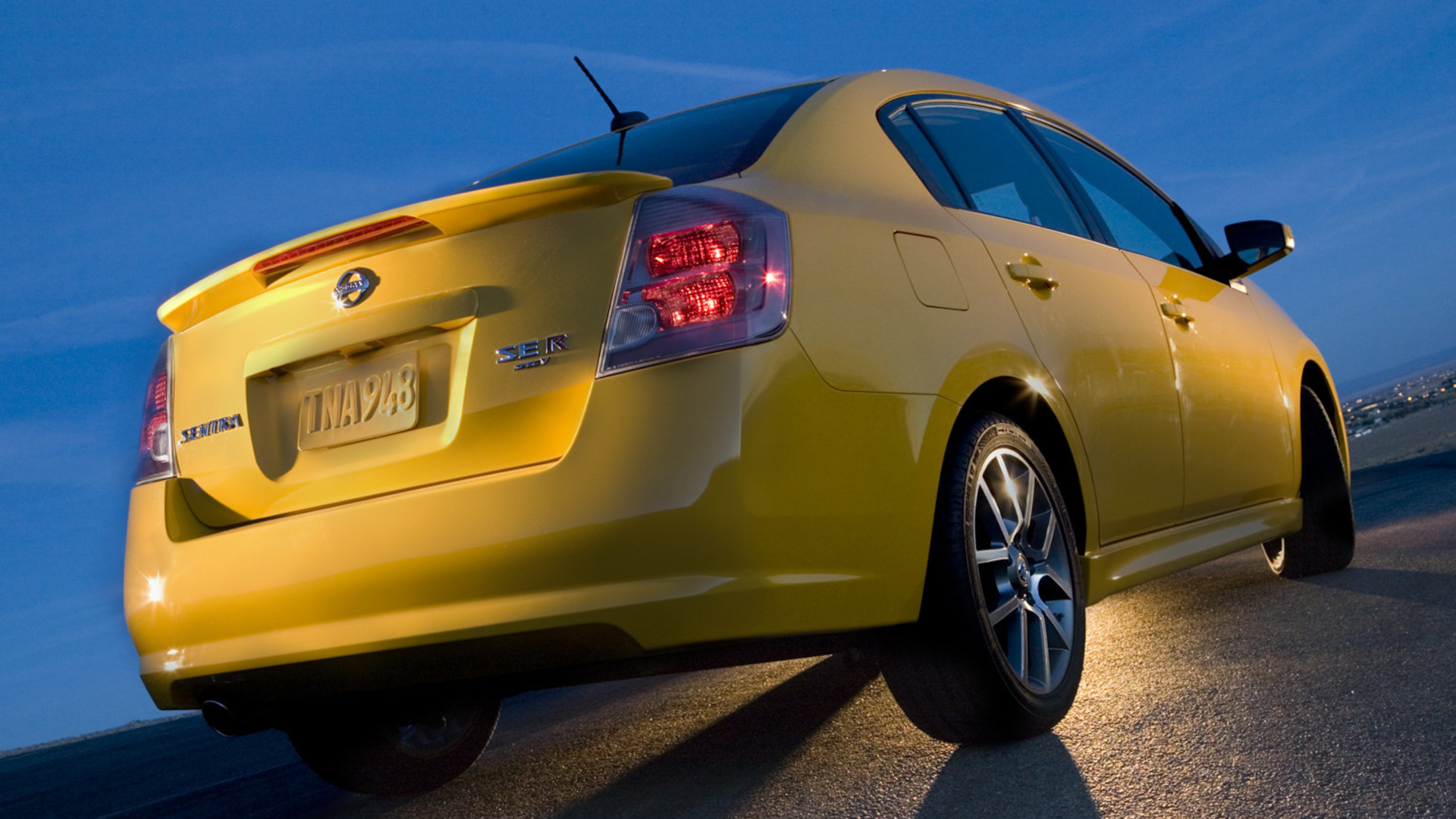
Nissan should probably have put the sixth-generation Sentra on a diet because it spawned the largest and heaviest SE-R model yet. The company still kept the base and Spec V badges, but marketers were clearly aiming at a more mainstream market. Customers still got the QR25D, producing 200 hp in Spec V trim, but this car also had a lot more space for passengers and cargo and a much-improved interior. Now, you’d find Bluetooth, upgraded audio, and other daily driver amenities that spoke to the mainstream.
Nissan didn’t forget about performance, and the Spec V had a six-speed manual, optional limited slip diff, tuned suspension, and bigger brakes. So, even though it was heavier than previous versions, the vehicle still had good enthusiast capability, and it felt stable and responsive on the road. Basically, this iteration of the Sentra SE-R was a lot more livable for daily drivers than previous versions. Today, the Spec V is an enticing proposition for first-time buyers, with KBB estimating $5145 for a 2009 version. It has a newer model’s reliability and daily comfort, yet still offers real performance. Plus, it doesn’t look particularly sporty, making the sedan a stealthy speed machine wrapped up in an economy sedan.

Related
These Are 12 Of The Coolest Everyday Japanese Cars Of The 1990s
After the malaise of the previous decade, the 1990s were a new golden era for everyday performance, and Japanese automakers got in on the fun.
Sentra Nismo (2017-2019)
The Turbo Special That Never Really Made It
|
Engine |
1.6-liter Turbo Inline-4 |
|---|---|
|
Transmission |
Six-speed manual or CVT |
|
Drivetrain |
Front-wheel drive |
|
Power |
188 hp |
|
Torque |
177 lb.-ft |
In the late 2010s, Nissan was moving away from compact performance sedans but decided to give them one last hurrah in the shape of the Sentra Nismo. It wasn’t quite a direct continuation of the SE-R but nevertheless had plenty of spirit. The Nismo had plenty of potential with its 1.6-liter turbocharged MR16DDT four-cylinder engine, rated at 188 hp. The powerplant links to either a six-speed manual or a CVT, with most purists opting for the former. However, the car was only on sale between 2017 and 2019, and the limited time didn’t give people a lot of time to check it out, making this model largely forgotten today.
The styling department at Nismo gave this car the full treatment with 18-inch wheels, aggressive-looking bumpers, red accents, and sturdy sports seats. It had a stiffer suspension with a quick steering rack, and the ride was much firmer than the base Sentra. It didn’t have a limited slip diff, but it did make the most of its turbocharged torque, especially in the mid-range. It may have had a lot of performance upgrades, but it still felt genuinely fun and composed during daily driving.
Perhaps the Nismo is the best all-around choice if you’ve got a little more money burning a hole in your pocket – $8494 for a 2017 version, according to KBB. After all, it has everything you’d expect in a modern daily driver, such as keyless start, smartphone integration, a full suite of safety tech, and reasonable gas mileage. And as it’s the last sporty Sentra to leave the factory, it could become a collective curiosity in the years ahead.
Sources: Nissan, Bring a Trailer, Kelley Blue Book.