
How B2B Market Research Assists in Decision-Making
B2B Market Research Assists in Decision-Making
Getting a clearer understanding of customer behaviors and business landscapes is a must for businesses that want to develop effective marketing strategies. B2B market research helps identify and understand these trends, allowing businesses to capitalize on them to grow revenue and improve business outcomes.
In addition to understanding customer needs and wants, market research provides insights into competitive landscapes and industry trends. This empowers companies to assess competitor strengths and weaknesses, anticipate market shifts, and devise strategies to mitigate risks. It helps businesses spot gaps in the market, emerging trends, and unmet customer needs that can lead to new product or service offerings.
Understanding customer pain points and business needs is a key to developing effective marketing messaging. This messaging can help drive brand awareness, increase product sales, and build brand loyalty. However, obtaining accurate customer insights can be difficult. b2b market research allows businesses to collect data from a large audience and use analytical tools to uncover patterns, trends, and actionable insights that can inform their strategy.
B2B market research can be conducted in a number of ways, depending on the objective and the desired outputs. Surveys are a common strategy that allow researchers to gather quantitative data from a wide audience, while interviews offer the opportunity to explore deeper topics with key stakeholders. In-person and virtual focus groups facilitate facilitated discussions and enable participants to express their opinions in a safe environment.
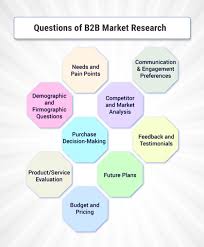
How B2B Market Research Assists in Decision-Making
Unlike consumer markets, which are relatively large with a high number of potential respondents for surveys, B2B markets are typically more niche and have fewer prospects that can be targeted with a survey. For this reason, a survey’s success often depends on reaching “statistical significance,” which requires the researcher to obtain enough responses from the target population to be confident of the findings’ statistical validity.
As such, B2B research often requires a more creative approach to collecting data. Capitalizing on existing networks can be an effective way to recruit participants for a B2B survey, as is tapping into professional organizations and industry events. In addition, online forums and social media communities for business professionals may provide access to a highly-qualified pool of participants with a variety of business experience and industry expertise.
B2B (business-to-business) market research is an essential process for companies seeking to understand the dynamics of the market in which they operate. It involves the collection, analysis, and interpretation of data regarding other businesses as potential customers, competitors, suppliers, and partners. By providing insights into market trends, customer behaviors, competitor strategies, and industry developments, B2B market research helps companies make informed decisions that can drive growth, optimize operations, and enhance their competitive advantage.
In the B2B landscape, decision-making is often more complex and driven by multiple stakeholders across different departments, such as finance, operations, and procurement. As a result, understanding the motivations, pain points, and purchasing behaviors of business buyers is more intricate compared to B2C (business-to-consumer) research. The long sales cycles, higher transaction values, and the need for relationship-building in B2B transactions make market research even more critical.